
Quick Summary
- Clear PET cup quality begins upstream with resin grade, moisture control and sheet processing, but most cup buyers do not need to specify resin IV themselves. The practical purchasing target is consistent finished-cup clarity, rigidity, weight, dimensions, rim geometry and lid fit against an approved reference.
A clear PET cup does not become clear, rigid and dimensionally consistent simply because the raw material is labeled “PET.” The finished cup reflects a chain of upstream decisions: resin grade, molecular weight, intrinsic viscosity, moisture control, thermal history, sheet quality, thermoforming and dimensional control.
This distinction matters because PET is used in many different industries. Bottle, film, fiber, sheet and engineering applications do not necessarily use the same resin grade or the same processing window. A technical number taken from a bottle-resin data sheet should not automatically become a specification for a thermoformed cup.
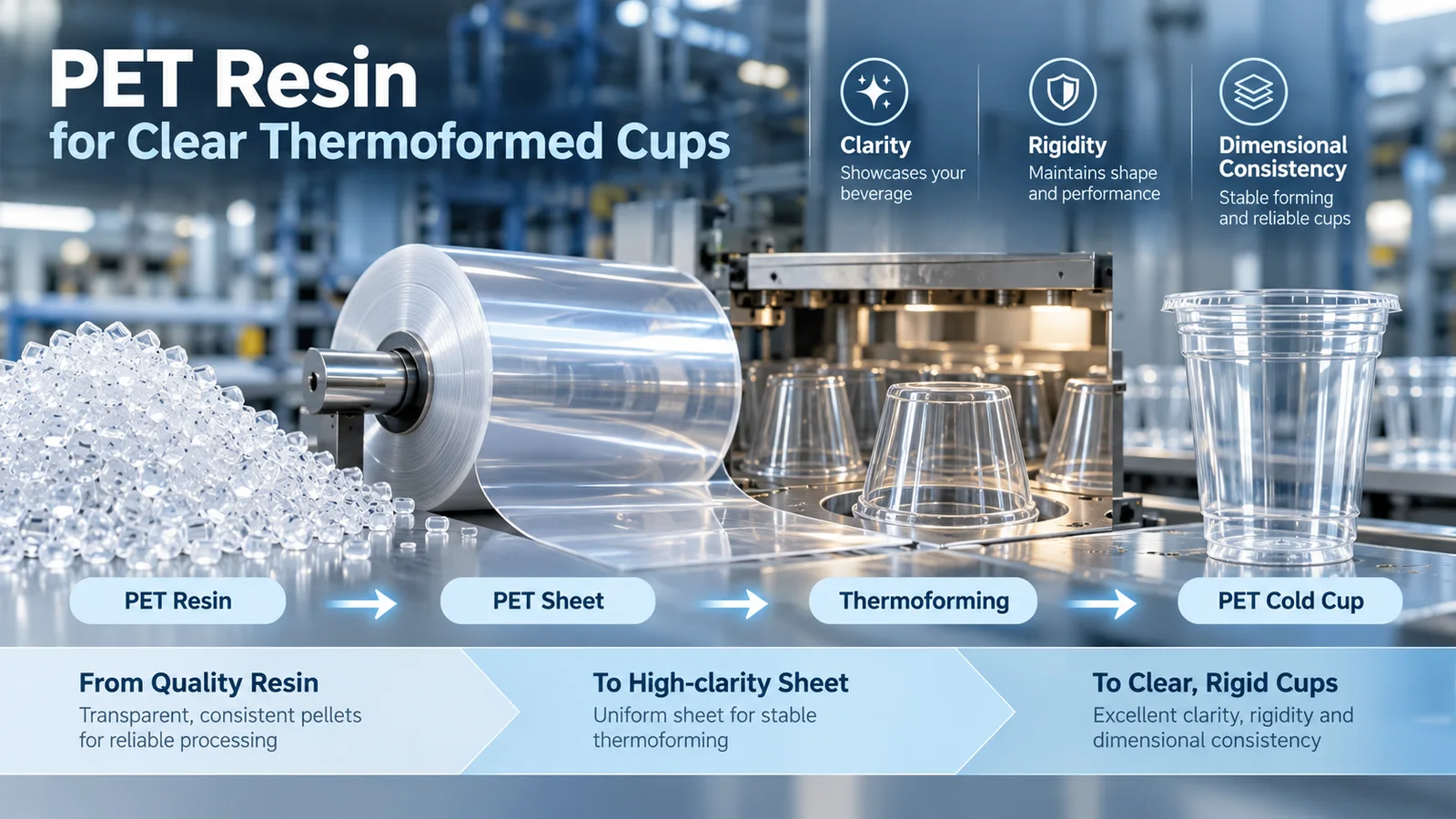
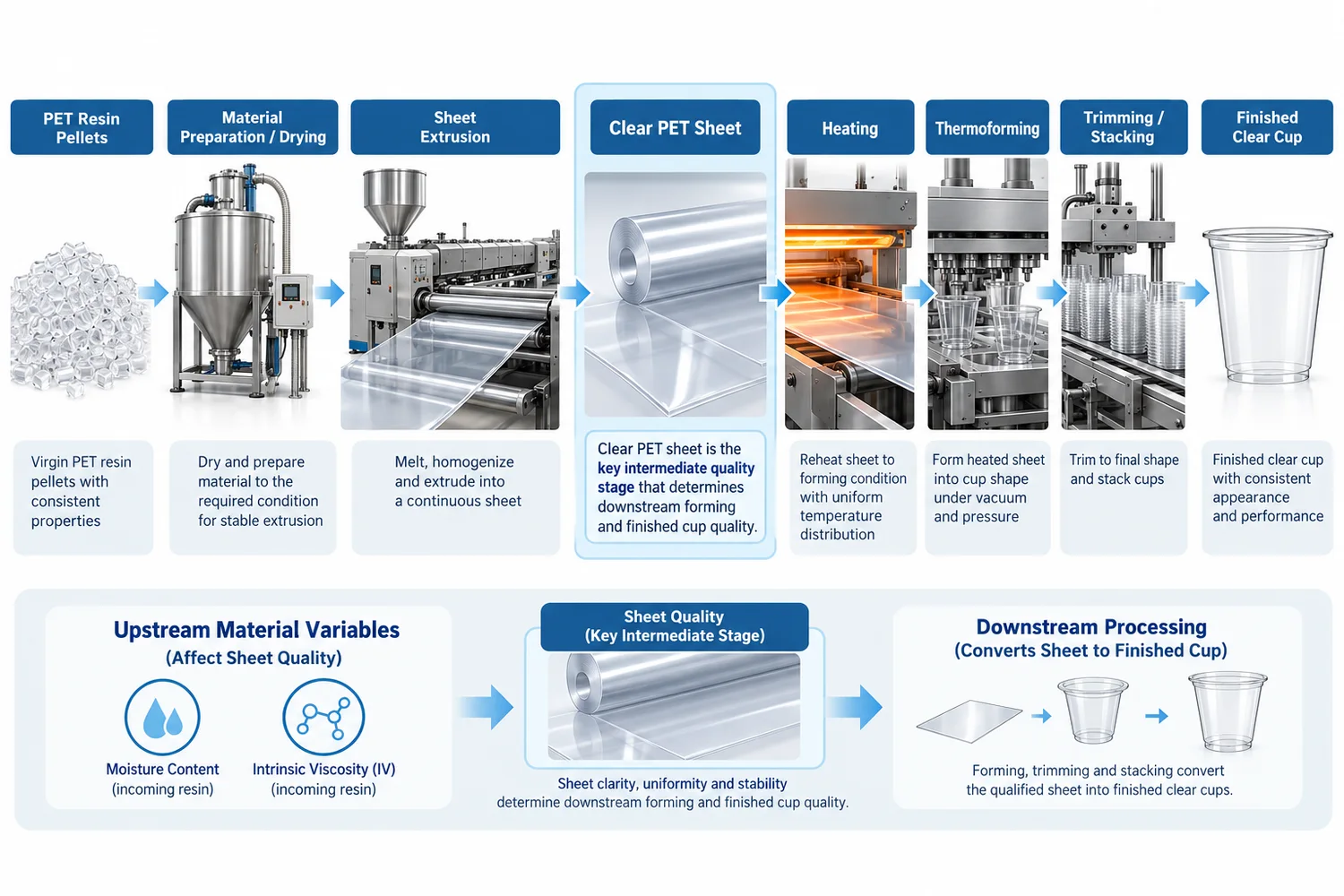
For clear disposable cups, the relevant manufacturing chain is narrower: PET resin → material preparation → sheet extrusion → clear PET sheet → thermoforming → trimming and stacking → finished cup inspection. Understanding that chain helps buyers ask better quality questions without turning the cup RFQ into a resin-purchasing specification.
What PET Resin Is Used for Clear Thermoformed Cups?
PET, or polyethylene terephthalate, is a thermoplastic polyester used in bottles, rigid packaging, films, fibers and other products. Commercial PET is supplied in multiple grades because different manufacturing processes require different combinations of melt behavior, molecular weight, crystallization behavior, color and end-use performance.
For a clear thermoformed cup, the resin must first support consistent sheet production. That sheet then has to heat and form predictably into the cup mold while preserving the required transparency, wall distribution, rim geometry and dimensional stability.
This is why “food-grade PET” by itself is not a complete manufacturing specification. Food-contact suitability addresses one requirement. It does not by itself define whether the resin is suitable for a particular sheet-extrusion and thermoforming process.
For buyers who are deciding whether PET is the right finished cup material rather than investigating the resin itself, the PET cups category and the PET vs PP scientific comparison are more direct starting points.
What Does PET Intrinsic Viscosity (IV) Mean?
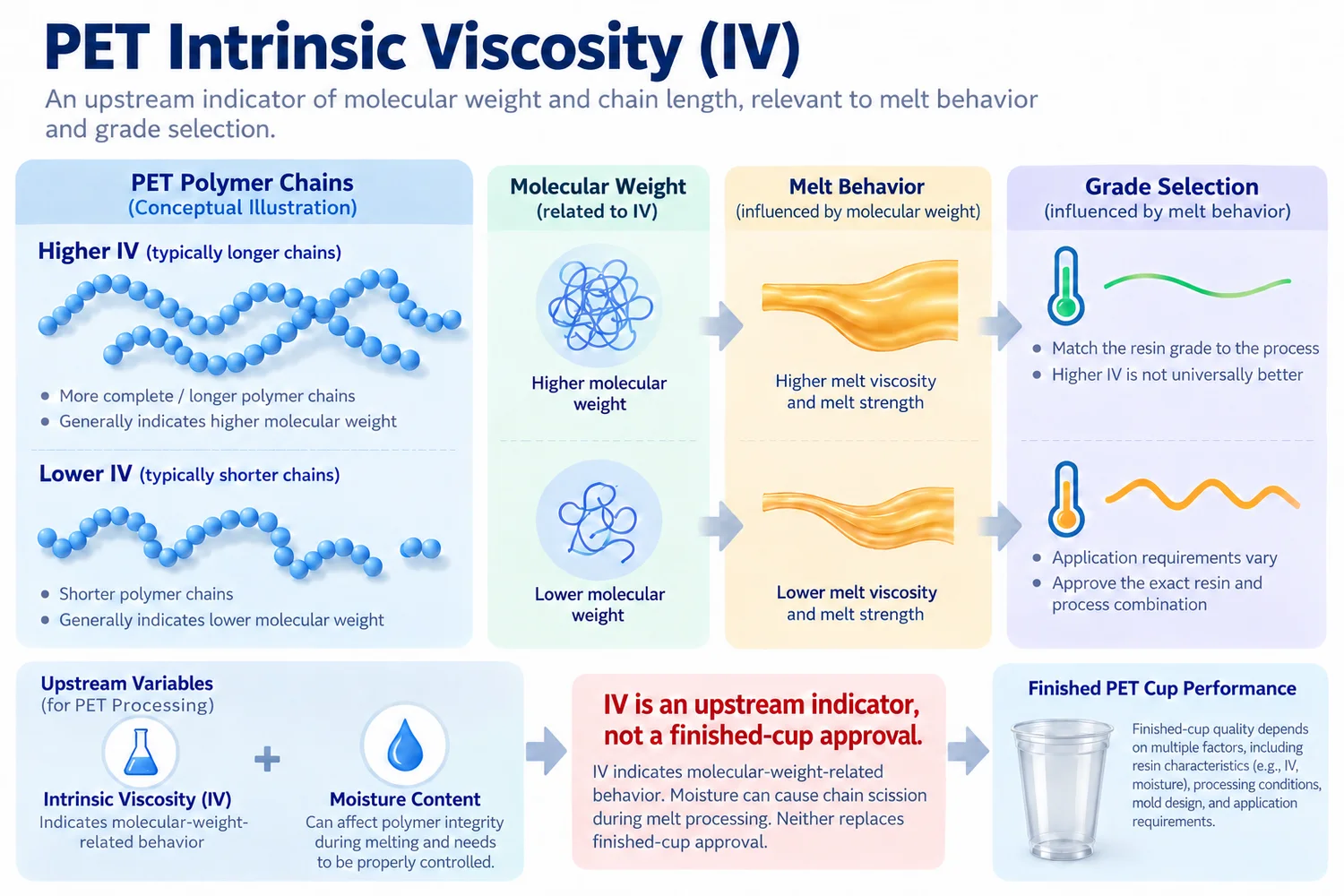
Intrinsic viscosity, usually shortened to IV, is a resin property used as an indirect indicator of PET molecular weight and polymer chain length. In practical terms, IV helps describe how the resin behaves during melt processing and how much molecular structure is available to support the required mechanical performance.
Higher IV does not automatically mean “better PET.” Different applications use different grades. A resin optimized for pressurized bottles, for example, may have different requirements from a resin intended for sheet extrusion. The useful question is whether the selected resin grade is appropriate for the manufacturing process and finished product.
| What IV Can Help Indicate | What IV Does Not Prove by Itself |
|---|---|
| Relative molecular-weight level of the PET resin | That a finished cup will have the correct dimensions |
| Melt behavior relevant to processing | That a cup will fit a particular lid |
| Whether molecular degradation may have occurred when compared under controlled conditions | That a higher number is universally better for every PET application |
| One resin-quality variable to monitor with other properties | Finished-cup clarity, rigidity or appearance without considering processing |
For the cup buyer, IV is therefore best understood as an upstream control variable. It explains why material handling and thermal processing matter, but it should not replace finished-product approval.
Why PET Resin Must Be Dried Before Melt Processing
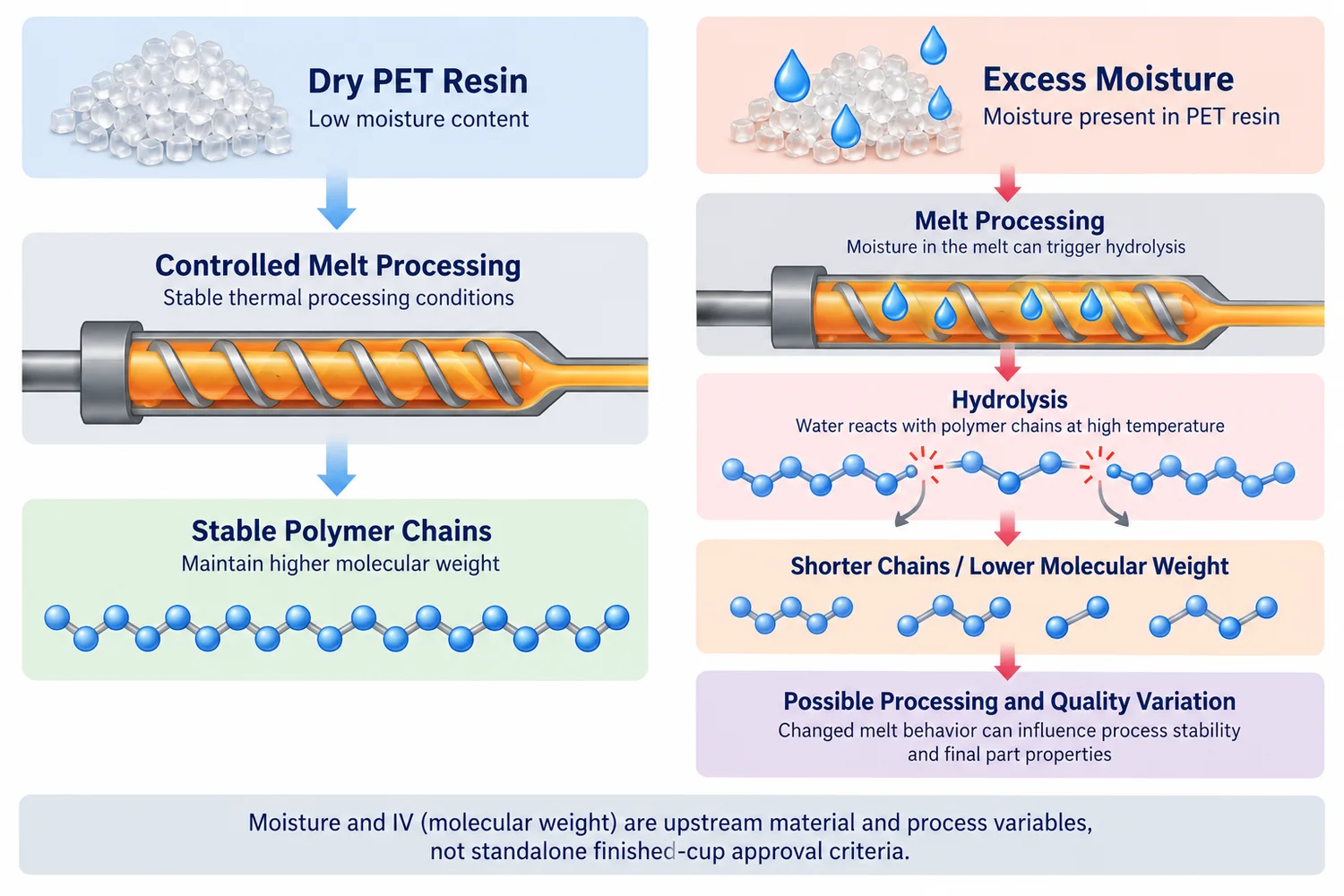
PET is moisture-sensitive during melt processing. If excessive moisture is present when the polymer is heated into the molten state, water can promote hydrolytic chain scission. In simple terms, polymer chains are shortened, molecular weight falls and the material no longer behaves exactly as the original resin was intended to behave.
This is why drying is not merely about removing visible water from the pellets. PET pellets can absorb moisture from the surrounding environment even when they look completely dry. Manufacturing therefore requires controlled material preparation before extrusion.
Excess moisture before melt processing → hydrolysis during processing → shorter PET chains → lower molecular weight / IV → changed melt behavior and potentially reduced finished-product consistency.
The exact drying conditions depend on the resin grade, equipment and production system. A buyer should not take a generic drying temperature from an online article and write it into a cup purchase order. The manufacturer should follow the applicable resin and processing requirements for the selected production system.
How Can Moisture-Related Degradation Affect PET Cup Quality?
Moisture-related molecular degradation occurs upstream, but the buyer sees the result only after the material has become sheet and then a cup. The relationship is therefore indirect. A change in molecular weight can alter melt strength and processing behavior, which can make consistent sheet extrusion and forming more difficult.
Possible downstream symptoms can include reduced toughness, unstable forming behavior or greater variation in finished parts. But one important diagnostic rule should be kept clear:
The same logic applies to other quality complaints. A haze problem does not automatically prove “bad resin,” and a weak rim does not automatically prove “low IV.” Finished-cup defects should be traced back through sheet, forming, dimensions and material records rather than assigned to one resin variable without evidence.
Why Do Some PET Cups Look Hazy Instead of Crystal Clear?
PET can provide high optical clarity, but transparency depends on more than the polymer name. Clear rigid PET packaging is generally associated with a predominantly amorphous transparent structure, while increased crystallization can scatter light and reduce transparency.
Haze can also be influenced by the quality of the extruded sheet, thermal history, cooling, contamination, additives, surface condition and recycled-material variation. That means the useful QC question is not simply “Is this PET?” but “Does the finished cup meet the approved appearance standard under the same inspection conditions?”
| Finished Appearance Issue | Variables to Investigate |
|---|---|
| General haze | Crystallization, sheet condition, cooling history, contamination, material blend and surface quality |
| Yellow or off-color appearance | Resin color, recycled-content variation, contamination and thermal history |
| Localized cloudy zones | Sheet uniformity, heating pattern, forming conditions or local material variation |
| Clear cup but inconsistent visual quality between lots | Raw-material lot, sheet production, recycled-content specification, process consistency and approval reference |
For B2B purchasing, clarity should therefore be treated as a finished-product acceptance criterion. If transparent product presentation matters for iced coffee, juice, fruit, desserts or other cold foodservice, approve a physical sample and use it as the visual reference for bulk production.
How Does Crystallinity Affect PET Clarity?
PET is a semi-crystalline polymer, meaning its molecular chains can exist in more disordered amorphous regions and more ordered crystalline regions. This structure is one reason processing history has such a strong influence on PET appearance and performance.
For transparent sheet and cups, the manufacturing process must preserve the required optical state while still achieving stable handling and forming. If crystallization becomes excessive in a transparent application, the material can lose the glass-clear appearance buyers expect from clear PET packaging.
Crystallinity should not be interpreted as “good” or “bad” by itself. Different PET applications deliberately use different morphology and thermal histories. What matters for a cold-drink cup is whether the selected resin, sheet process and thermoforming conditions produce the approved transparent finished part consistently.
How Do Temperature, Residence Time and Processing History Affect PET?
PET must be melted to produce sheet, but melt processing also creates a quality-control challenge: the material needs enough heat to process correctly without unnecessary degradation from excessive thermal exposure, moisture or extended residence time.
The process variables are connected. Temperature cannot be evaluated alone. Moisture level, residence time, shear, extrusion conditions, sheet cooling and the characteristics of the selected resin grade all affect the result.
When Process Control Is Weak
- Material may not melt or flow consistently.
- Thermal history may vary between production runs.
- Sheet appearance and thickness can become less consistent.
- Downstream thermoforming becomes harder to stabilize.
Why One Temperature Is Not the Answer
- Different PET grades are designed for different processes.
- Equipment and throughput change actual thermal history.
- Residence time changes the effect of temperature.
- Moisture can accelerate molecular degradation during melt processing.
This is another reason buyers usually should not specify an extrusion-temperature number themselves. The commercially useful requirement is that production yields a consistent finished cup against the approved specification.
What Is APET Sheet, and Why Is It Relevant to Clear Cups?
In rigid packaging, APET commonly refers to amorphous PET used in clear sheet and thermoformed packaging. The term describes the physical form and morphology relevant to transparent rigid packaging; it is not a statement that the material is virgin or recycled.
This distinction matters because buyers sometimes compare “APET” with “rPET” as though they were opposing material categories. They are not the same type of classification:
| Term | What It Describes | Buyer Implication |
|---|---|---|
| APET | Amorphous PET form commonly associated with clear rigid sheet / thermoformed packaging | Relevant to transparency and thermoforming behavior |
| Virgin PET | Feedstock made from newly produced PET resin rather than recycled PET content | Defines material origin, not whether the final sheet is amorphous |
| rPET | PET containing recycled feedstock | Requires control of recycled-content level, quality, appearance and applicable food-contact requirements |
A thermoformed cup can therefore involve APET sheet while its feedstock strategy may be virgin PET, recycled PET or an approved combination, depending on the exact product and destination-market requirements.
Virgin PET and rPET: What Changes for Thermoformed Cups?
Virgin PET and recycled PET belong to the same polymer family, but recycled feedstock introduces additional sourcing and process-control questions. Recycled-content percentage, purification quality, contamination control, color, intrinsic viscosity and food-contact suitability can all affect how an rPET program is specified.
For the finished cup buyer, the key issue is not whether rPET is inherently “good” or “bad.” It is whether the recycled-content requirement is clearly defined and whether the resulting cup consistently meets the approved appearance, mechanical and dimensional specification.
In practical terms, increasing recycled content may require tighter control of material consistency and color expectations. Buyers should avoid assuming that all rPET feedstock produces the same optical result or that a general recycled-content claim automatically proves food-contact suitability for every destination market.
From PET Resin to Clear Sheet
Before thermoforming starts, the resin has to become a controlled sheet. This intermediate stage is critical because the forming machine can only work with the sheet it receives.
- Material selection and preparation: The resin program is selected for the required packaging application and prepared for processing.
- Moisture control: Material is dried and handled to protect it from moisture-related degradation during melting.
- Melting and extrusion: PET is melted and extruded into a continuous sheet.
- Thickness and surface control: The sheet needs appropriate gauge consistency and appearance for the target cup geometry.
- Cooling and winding / feeding: Thermal history is controlled so the sheet remains suitable for later thermoforming.
A cup factory can receive or make resin that meets a material specification and still produce a poor cup if sheet control is weak. Conversely, stable sheet production helps the forming process reproduce the approved cup geometry from cycle to cycle.
From PET Sheet to the Finished Cup
Thermoforming reheats the sheet and forms it into the cup geometry. At this stage, material is distributed into the sidewall, bottom and rim. Even when the resin is correct, forming consistency still determines whether the cup has the intended dimensions, wall distribution and lid interface.
The buyer therefore experiences resin quality only through the finished product. A resin certificate cannot prove that the cup has the correct top diameter. A sheet specification cannot prove that the lid snaps correctly. Those are finished-part questions.
| Finished Cup Observation | Possible Upstream Variables to Investigate |
|---|---|
| Hazy appearance | Resin / blend, crystallization, sheet quality, cooling, contamination, thermal history |
| Yellow or off-color cup | Material color, recycled-content variation, contamination, thermal history |
| Brittle cracking | Molecular degradation, wall distribution, excessive thinning, trimming damage, material quality |
| Uneven wall thickness | Sheet gauge, heating distribution, forming behavior, cup geometry |
| Weak or distorted rim | Material distribution, forming, trimming and dimensional control |
| Lid-fit variation | Rim geometry, dimensional repeatability, cup/lid series and forming consistency |
What Can a PET Resin COA Tell a Manufacturer?
A resin Certificate of Analysis or product specification may include properties such as intrinsic viscosity, moisture, color, acetaldehyde, melting behavior or other grade-specific controls. The exact list depends on the resin supplier and grade.
These documents are useful for incoming material control because they help establish whether the supplied resin lot is within the agreed upstream specification. They do not replace finished-cup inspection.
Resin COA → confirms selected upstream resin properties.
Finished-cup QC → confirms appearance, weight, dimensions, rim geometry, lid fit and other approved cup requirements.
This separation is important in B2B claims. A resin document should not be presented as proof that every finished cup automatically meets all dimensional, mechanical, food-contact or destination-market requirements. The scope of each document needs to match the claim being made.
What Should PET Cup Buyers Actually Specify?
For most importers, distributors, beverage brands and foodservice buyers, writing a resin IV target into the PO creates complexity without solving the real purchasing problem. The buyer normally needs a repeatable cup system, not a polymer-processing recipe.
A practical finished-cup specification should focus on what must remain consistent from approval through bulk production:
- Material: Confirm PET and any agreed virgin / recycled-content requirement.
- Application: Confirm the cup is intended for the required cold-foodservice use.
- Nominal capacity: Record the required oz / mL size.
- Dimensions: Confirm top diameter, bottom diameter, height and other drawing dimensions where relevant.
- Rim geometry: Approve the rim that interfaces with the selected lid system.
- Lid compatibility: Approve the exact cup-and-lid combination physically.
- Cup weight: Use the agreed product specification or approved reference rather than assuming all cups of one capacity weigh the same.
- Clarity and appearance: Set an acceptable visual reference for transparency, color and visible defects.
- Rigidity / handling: Confirm the finished cup performs as required for filling, handling, stacking and serving.
- Approved sample: Keep a controlled physical or documented approval reference for bulk and repeat orders.
For a product shortlist, compare the 12 oz PET cup range and 16 oz PET cup range, then confirm the exact variant, rim and lid rather than treating capacity as a complete specification.
For size and rim approval, see the PET Cup Sizes Guide. For shipment inspection, use the Plastic Cup Quality Control Guide. If the order is still at approval stage, the Plastic Cup Sample Approval Guide explains how to establish a usable reference before bulk production.
A Better Way to Think About PET Cup Quality
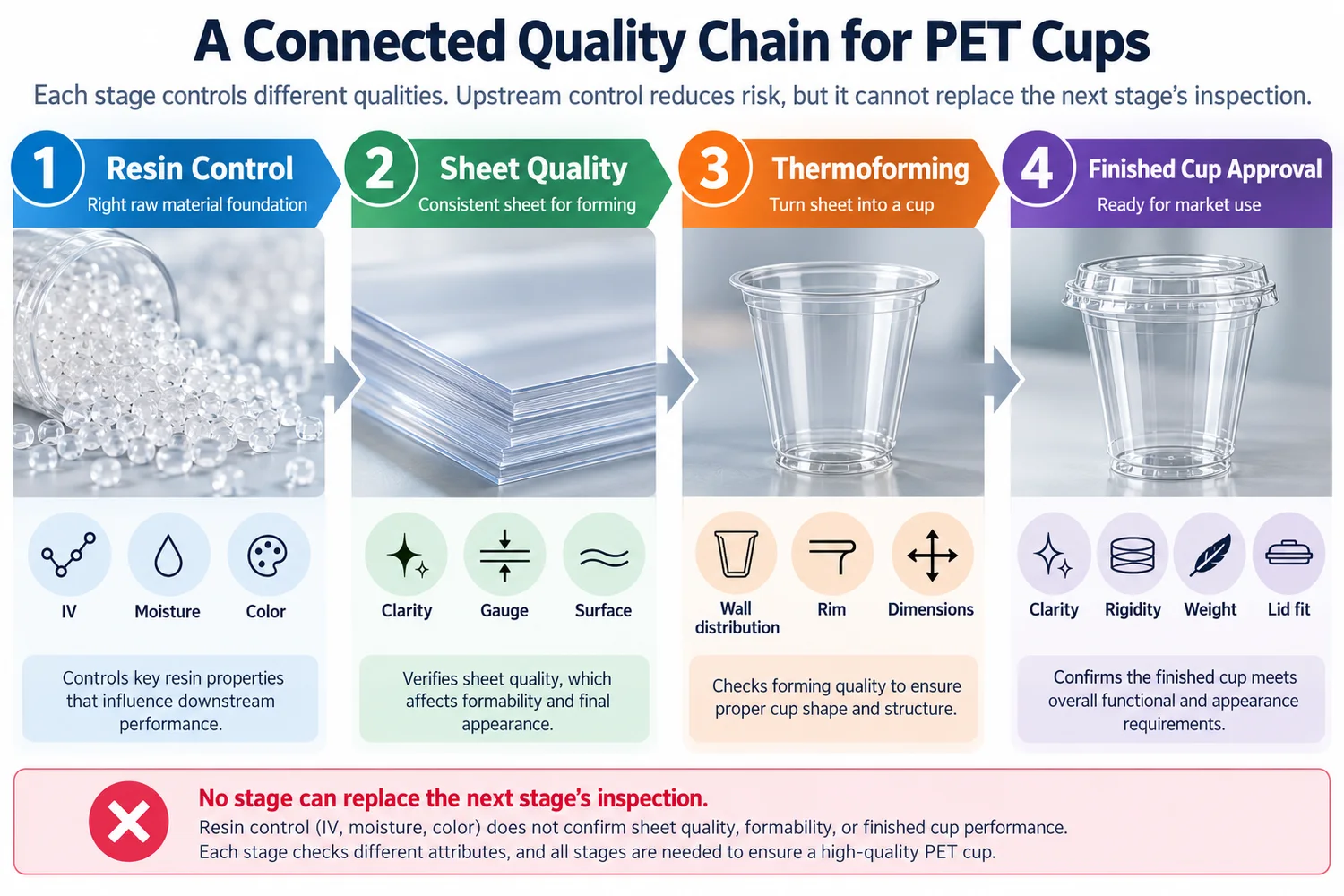
The useful quality model is not “good resin equals good cup.” Each stage has to preserve the previous stage's quality while adding its own control.
Upstream Material Control
Resin grade, IV, moisture, color and other supplier specifications help determine whether the material is suitable and stable enough for the selected processing route.
Sheet Quality Control
Sheet extrusion translates resin into the material that will actually enter the thermoforming process. Gauge, appearance and thermal history matter.
Thermoforming Control
Heating and forming determine how material is distributed through the sidewall, bottom and rim and whether dimensions remain stable.
Finished-Cup Approval
The final buyer decision should be based on the approved cup: appearance, weight, dimensions, rim, lid fit, handling and packing.
Buyer Checklist: PET Resin Knowledge Without Over-Specifying the Cup
- Is the product clearly specified as PET rather than a different polymer?
- Is any virgin / recycled-content requirement written separately from the APET sheet terminology?
- Has the supplier confirmed that the material grade is suitable for the actual sheet / thermoforming process?
- Is moisture control treated as a manufacturing requirement before PET melt processing?
- Are clarity and color evaluated on the finished cup rather than inferred only from the resin name?
- Are brittle, hazy or weak-rim complaints investigated as multi-variable problems rather than blamed on one property automatically?
- Are finished cup weight and dimensions controlled against the approved specification?
- Is rim geometry verified with the exact lid series?
- Is a physical or documented approved sample retained for bulk and repeat-order comparison?
- Are resin-level documents kept separate from finished-product and destination-market compliance evidence?
Final Recommendation
PET resin science matters because the finished cup begins with polymer chains, moisture control and processing behavior. Intrinsic viscosity helps describe molecular-weight-related behavior; moisture can drive hydrolytic degradation during melt processing; crystallinity and thermal history influence transparency; and sheet quality determines what the thermoforming process has available to work with.
But a cup buyer does not need to become a resin process engineer to purchase correctly. The practical procurement boundary is straightforward: the manufacturer controls the upstream material and process variables; the buyer approves the finished product those controls must consistently produce.
For bulk sourcing, lock the PET material requirement, recycled-content requirement where applicable, clarity standard, cup weight, dimensions, rim geometry, lid pairing and approved sample. If a quality problem appears later, trace it backward through the finished cup, thermoforming, sheet and resin records instead of assuming that one technical number explains the defect.
To review a bulk-order specification, contact Bioleader Cups with the intended application, cup size, material requirement and sample-approval needs.
Frequently Asked Questions
What is PET intrinsic viscosity (IV)?
Intrinsic viscosity is a material property used as an indirect indicator of PET molecular weight and polymer chain length. It helps manufacturers understand processing behavior and resin consistency, but it does not by itself prove that a finished cup has the correct clarity, strength, dimensions or lid fit.
Why does PET resin need to be dried before processing?
PET is moisture-sensitive during melt processing. Excess moisture can promote hydrolysis, shortening polymer chains and reducing molecular weight. Proper material preparation helps protect the resin from moisture-related degradation before sheet extrusion or other melt-processing steps.
Why can a PET cup look hazy?
Haze can be associated with crystallization, sheet quality, cooling and thermal history, contamination, additives, surface condition or material-blend variation. A hazy cup should therefore be investigated across resin, sheet and forming variables rather than automatically blamed on one cause.
Is APET the same as virgin PET or rPET?
No. APET commonly refers to the amorphous PET form used for clear rigid sheet and thermoformed packaging. Virgin PET and rPET describe feedstock origin. A clear thermoformed PET product can therefore involve APET sheet while using an approved virgin, recycled or mixed feedstock strategy.
Should a PET cup buyer specify the resin IV in the purchase order?
Usually not unless the buyer has a validated technical reason and an agreed resin specification. Most cup buyers get better control by approving finished-cup material, recycled content where applicable, clarity, weight, dimensions, rim geometry, lid fit and a physical reference sample.