Quick Summary
- PET cups are generally the clearer option because commercial cup-grade PET is commonly formed with a largely amorphous structure that limits visible-light scattering.
- PP is a semi-crystalline polyolefin; its crystalline regions can increase haze, although clarified PP grades may look considerably clearer than standard PP.
- A quick visual check can screen samples, but resin marks, optical tests, and flex feel do not replace product specifications or food-contact documentation.
- PET is usually the starting point for cold drinks where presentation is critical; PP may be considered where verified temperature tolerance matters more than maximum clarity.
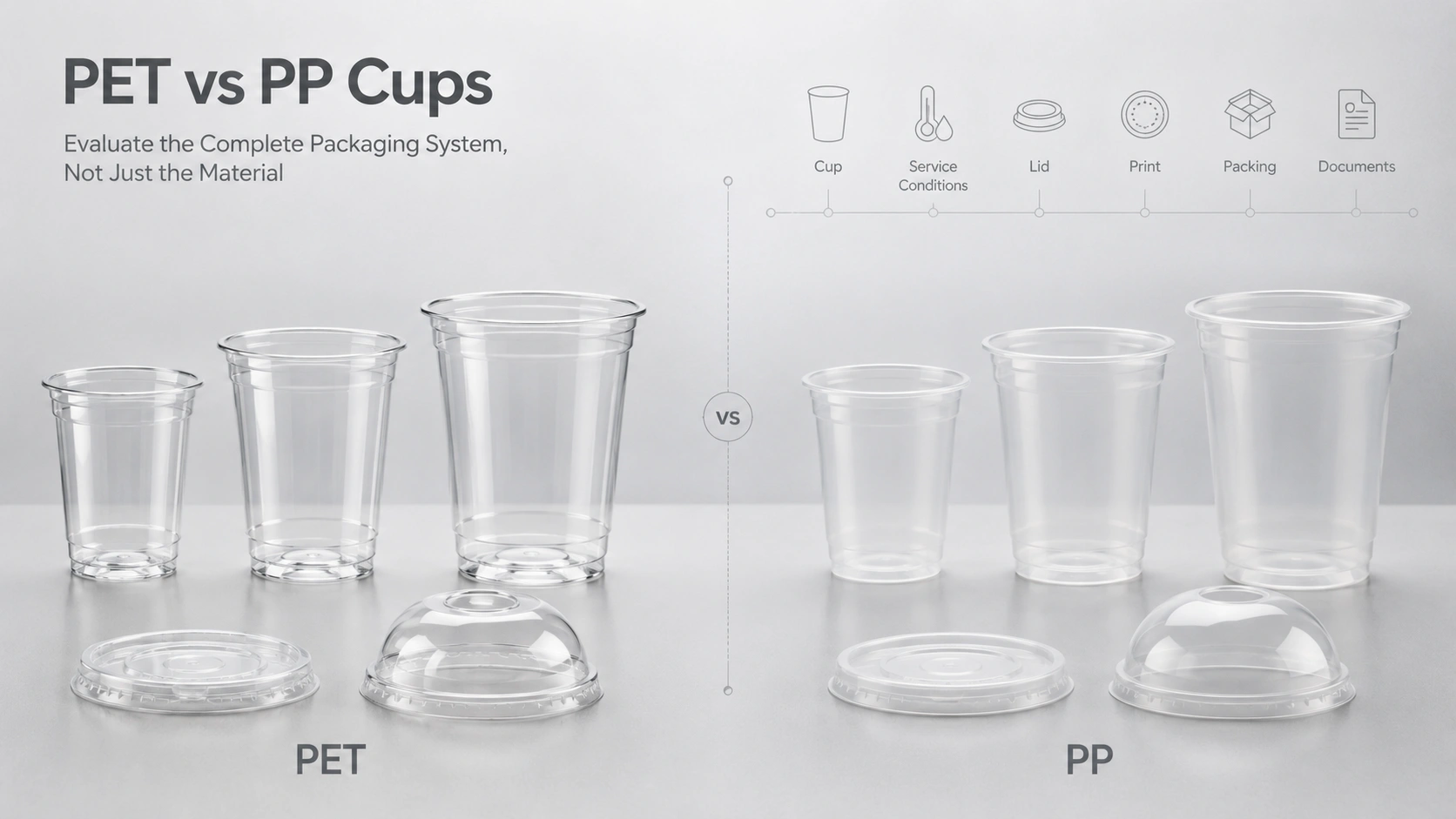
- Buyers should approve a complete packaging system—cup, rim, lid, print, packing, and documents—not a resin name alone.
Why the PET vs PP Cup Comparison Matters
PET vs PP cups is not a contest with one universal winner. PET is usually the better starting point for cold beverages when crystal-clear appearance, gloss, and visibility of colors or toppings are commercially important. PP may be the better candidate when the exact cup specification supports a more demanding temperature condition and a more translucent appearance is acceptable. Importers, distributors, beverage brands, and procurement teams should make the final decision from the complete cup system: material, geometry, rim, lid, printing, packing, intended use, and supporting documents.
The resin name explains part of the behavior, but buyers should still verify finished-cup performance against the intended service condition. Processing conditions, material grade, additives, wall thickness, cup design, and forming history all influence clarity, stiffness, heat response, and appearance.
The Cupschina Decision Principle
Approve a verified packaging system, not a resin name. A defensible approval includes the exact cup code, intended service conditions, rim and lid combination, print sample, carton specification, compliance documents, and an agreed physical sample.
The Science Behind PET and PP Cup Appearance
PET and PP can both be made into foodservice cups, but their molecular structure and solid-state morphology differ. PET is a polyester containing aromatic rings and ester groups. PP is a polyolefin built from a hydrocarbon backbone with methyl side groups. For cup buyers, the most visible difference is not the chemical formula itself; it is how each polymer arranges when it cools into a solid.
Why PET Often Looks Clearer
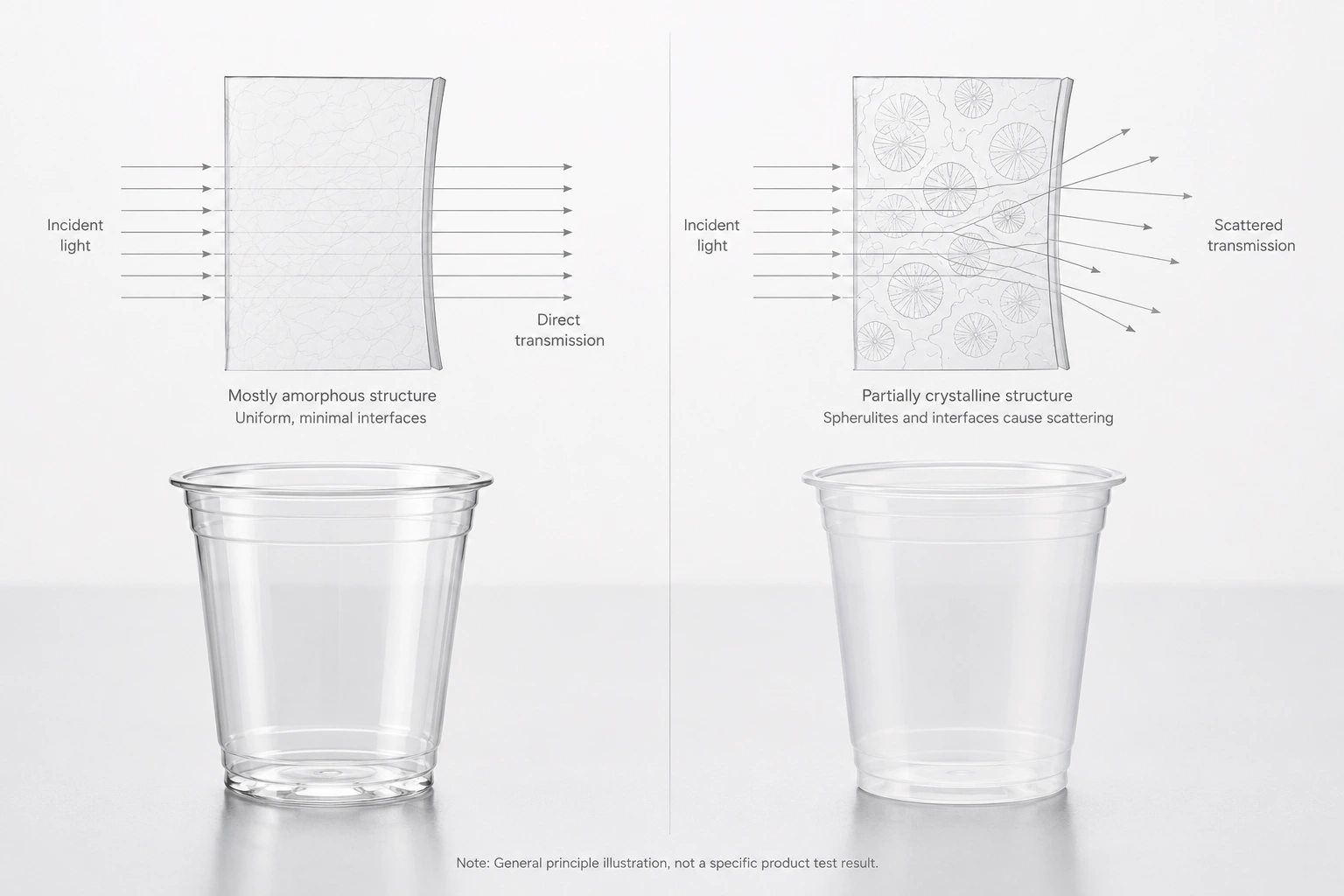
Commercial transparent PET articles are commonly produced so that much of the polymer remains amorphous rather than forming large crystalline structures. When internal regions are relatively uniform at the scale of visible light, less light is scattered and the viewer sees a clearer image through the wall. Scientific reviews describe fully amorphous PET as the form used when high transparency is required. PET can still become hazier when crystallization, surface texture, contamination, orientation, or processing defects increase light scattering. ([1])
Why PP Often Looks More Translucent
PP is normally semi-crystalline. Light can scatter at boundaries between amorphous and crystalline regions and around larger crystalline structures, creating haze and reducing image sharpness. Research on PP optical properties confirms that crystallinity and morphology affect transparency. ([2]) This does not mean all PP cups are cloudy: random copolymers, clarifying agents, fast cooling, and controlled processing can make some PP grades substantially clearer. The accurate statement is therefore “PET is usually clearer,” not “PP can never be clear.”
Haze Is Measurable, Not Just Subjective
ASTM D1003 and ISO 14782 describe instrumental approaches for evaluating haze and light transmission in transparent plastics. ([3]) For commercial cup comparisons, buyers can request measured optical data when visual presentation is a contract requirement. The test method, sample geometry, thickness, conditioning, and production lot should be stated because a generic resin value may not represent a formed cup.
PET vs PP Cups: Quick Comparison and Simple Identification
The table gives a practical first comparison. It is a screening tool, not permission to skip finished-product approval.
| Decision factor | PET cups | PP cups | What a buyer should do |
|---|---|---|---|
| Typical appearance | Usually clearer, glossier, and more glass-like. | Usually softer in appearance and more translucent; clarified grades can be much clearer. | Compare production-equivalent samples under the same light and against the same background. |
| Cold-drink presentation | Often preferred when beverage color, layers, fruit, foam, or toppings should remain visible. | Can work when maximum transparency is not the leading requirement. | Fill both samples with the intended beverage and review condensation, photos, and display conditions. |
| Temperature decision | Generally treated as a cold-service option unless the exact product documentation states otherwise. | Often offers greater temperature tolerance than PET, but the finished cup still requires verification. | Request the permitted filling, holding, and service conditions for the exact product. |
| Feel at similar geometry | Often feels crisper or stiffer. | Often feels more flexible and may rebound more easily. | Use only same-size, similar-wall samples; cup geometry can outweigh the material effect. |
| Resin identification mark | May be molded as PET or PETE with code 1. | May be molded as PP with code 5. | Treat the mark as material identification, not proof of food-contact compliance or local recyclability. |
| Lid fit | Controlled by rim diameter and geometry, not PET alone. | Controlled by rim diameter and geometry, not PP alone. | Match the approved cup code and lid code, then perform physical fit testing. |
Three Safe Screening Checks for a Non-Specialist
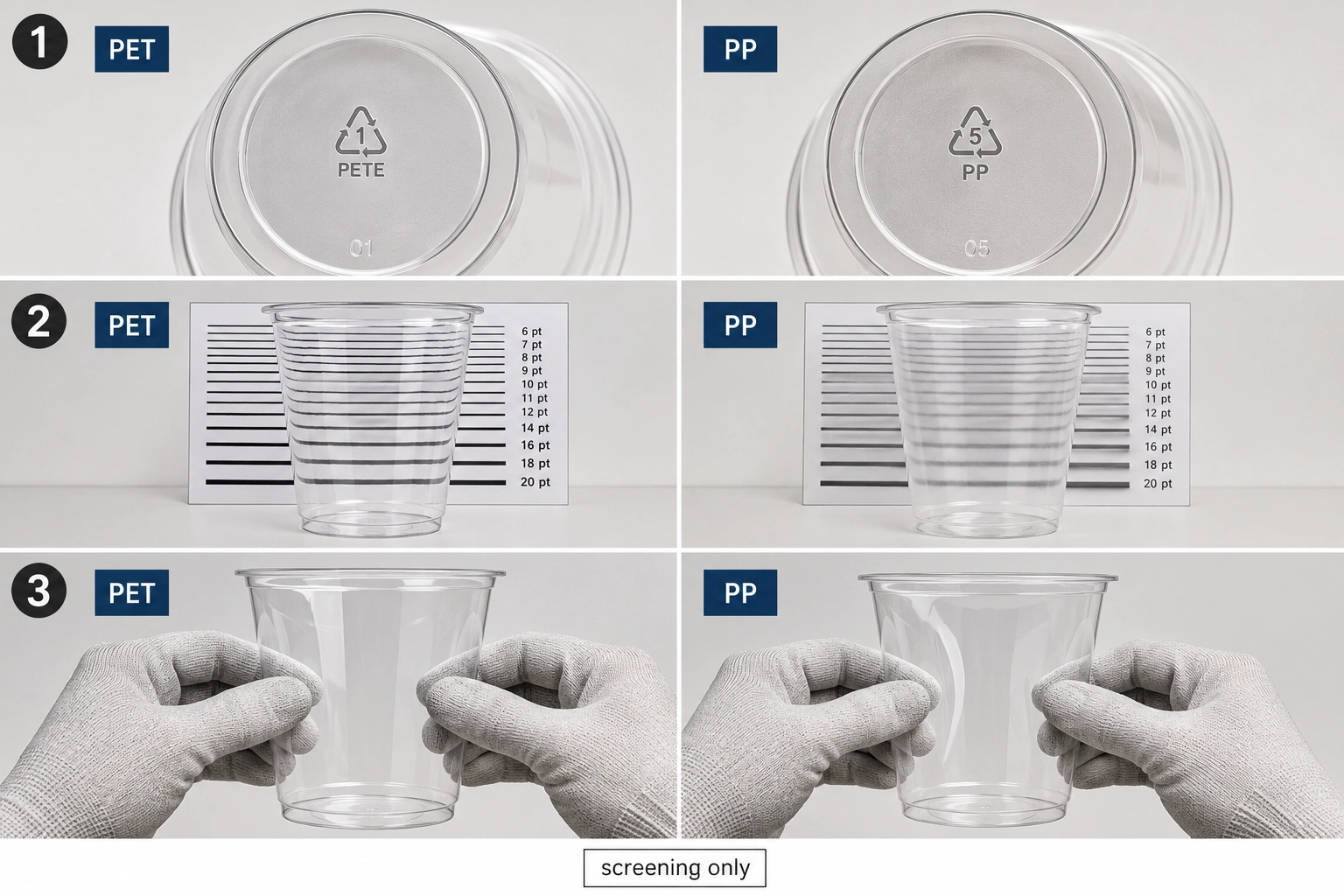
- Check the molded mark. A base mark may identify PET/PETE as resin code 1 or PP as resin code 5 under the resin identification system. ([4]) Missing or unclear marks require supplier confirmation.
- Use a black-line visibility check. Place identical empty cups over the same printed black lines at the same distance. PET will often preserve sharper edges; standard PP may show more haze. This compares appearance only.
- Compare controlled flex and rebound. Gently press the sidewalls of same-size samples with similar geometry. PP often feels more flexible, while PET often feels crisper. Do not identify material from feel alone.
Tests to Avoid
Do not burn, smell, microwave, boil, or deliberately overheat unknown cups to identify the resin. These methods are unsafe, can release fumes, damage the sample, and do not establish food-contact suitability. A density separation test on prepared laboratory specimens can distinguish many unfilled PET and PP materials, but whole cups trap air and additives can change behavior, so it is not a reliable receiving-inspection method.
When PET Cups Are Usually the Better Fit
Start with PET when the application is a verified cold-service program and the beverage is part of the visual product. Iced coffee, fruit tea, smoothies, layered drinks, desserts, and toppings can benefit from a cup wall that lets customers see color and texture clearly.
Appearance Is a Commercial Performance Factor
Clarity influences menu photography, delivery-platform images, display cabinets, grab-and-go merchandising, and perceived freshness. It can also reduce the amount of opaque artwork required to make a beverage look intentional. Buyers should still review a filled sample because condensation, scratches, wall thickness, nested-cup marks, and printed ink can reduce the clarity observed in an empty laboratory sample.
Limits That Must Be Confirmed
PET should not be selected for a hot-use program because it looks rigid or because a raw-material data sheet lists a melting point. A polymer can soften, shrink, creep, or deform well below melting, and a thin formed cup behaves differently from a standard laboratory specimen. Confirm filling temperature, contact time, lid conditions, stacking load, storage, and transport for the exact cup. PET must not be described as biodegradable, compostable, PLA, or plant-based.
When PP Cups May Be the Better Fit
PP deserves evaluation when the verified operating condition requires more temperature tolerance than a standard PET cold cup can provide and when the buyer can accept a less glass-like appearance. It may also be attractive where a more flexible cup wall or different forming behavior supports the product design.
Temperature Tolerance Needs a Use Condition
“PP is heat resistant” is incomplete procurement language. The buyer needs an exact product and an exact use condition: food or beverage type, initial filling temperature, duration of contact, whether the cup is lidded, stacking or sealing pressure, storage conditions, and consumer handling. FDA food-contact authorizations and guidance distinguish food types and conditions of use, reinforcing that material suitability is tied to intended conditions rather than a broad resin label. ([5])
Clarified PP Still Needs Sample Review
A clarified PP cup may look much better than a conventional PP cup, but it should not be assumed to match PET in every lighting condition or wall thickness. Compare image sharpness, haze, gloss, color cast, stress whitening, and print contrast using production-equivalent samples. If appearance is contract-critical, define an approved visual master or measurable optical criterion.
Buyer Decision Matrix and Complete System Verification
The most defensible comparison is not raw PET versus raw PP. It is one verified packaging system versus another verified packaging system.
| Buyer condition | Start with | Possible disqualifier | Evidence required |
|---|---|---|---|
| Maximum cold-drink clarity and glossy presentation | PET | Use condition exceeds the approved product specification | Filled sample, optical review, exact temperature and contact conditions |
| Higher verified temperature requirement | PP | More translucent appearance weakens the product presentation | Finished-cup use data, filled sample, deformation and handling review |
| Shared-lid or reduced-SKU strategy | Either material | Rim diameter or rim geometry differs | Cup drawing, lid code, assembled sample, leak and retention checks |
| Custom printed brand program | Either material | Ink opacity, color contrast, or registration is not approved | Production-equivalent printed sample on the final cup material |
| Importer or distributor mixed-material range | Both, separated by system | Similar capacity names cause cup-and-lid mixing | Distinct SKU codes, packing labels, warehouse controls, approved compatibility chart |
The Six-Part Verified Packaging System
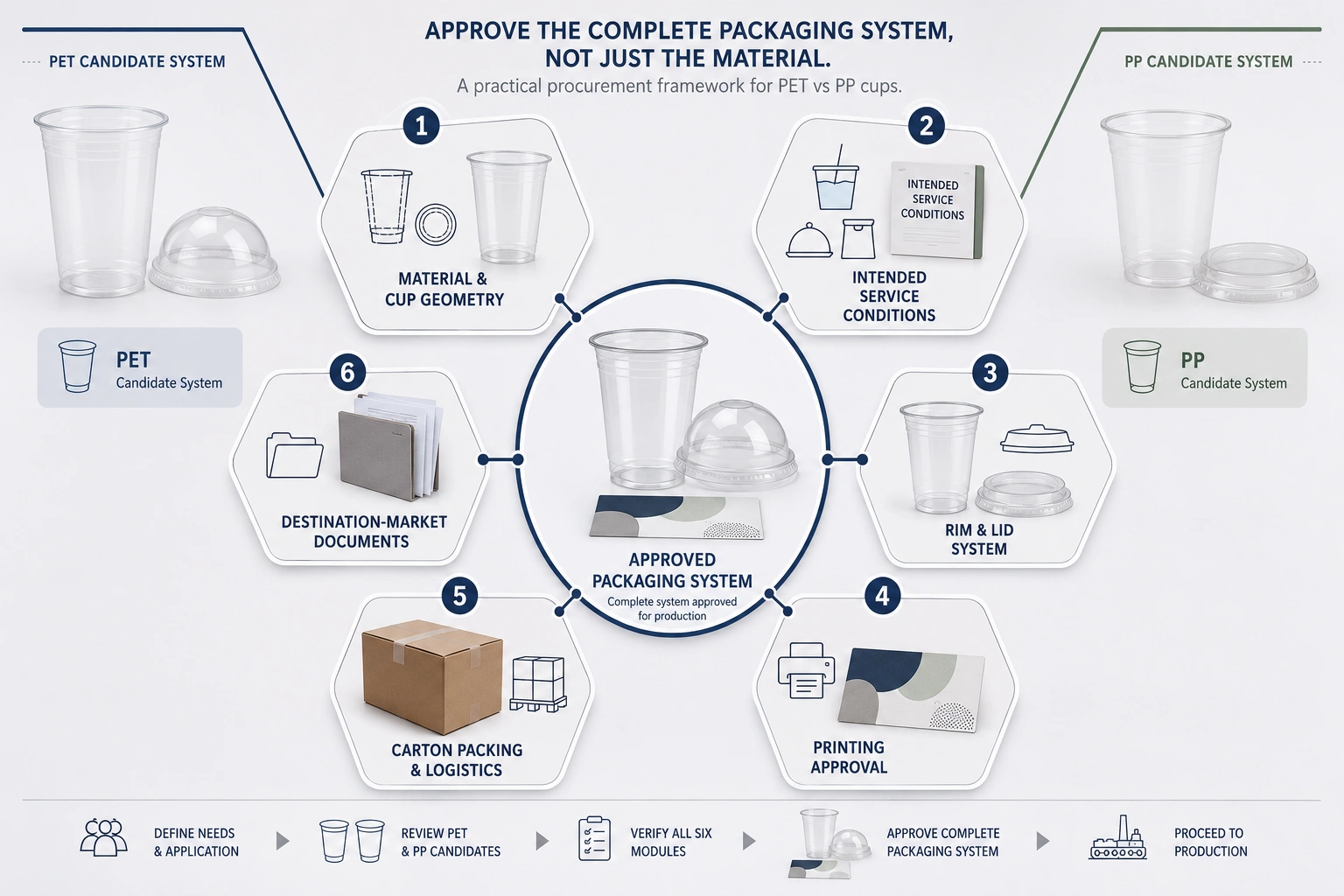
A complete approval should cover: 1) material and cup geometry, 2) intended service conditions, 3) rim and lid system, 4) printing and visual approval, 5) carton packing and logistics, and 6) destination-market documentation. EU food-contact rules likewise treat plastic articles through specific material, composition, migration, documentation, and intended-use requirements rather than a generic material claim. ([6])
Common Comparison Errors
Do not compare a thick PET cup with a thin PP cup and attribute every difference to chemistry. Do not use melting point as a finished-cup service-temperature guarantee. Do not order lids by ounce capacity. Do not treat resin code 1 or 5 as a recycling claim, a certificate, or a declaration of food-contact compliance. Do not approve print from a screen proof when the substrate appearance changes the color result.
Buyer Checklist and Procurement Process
Move from a broad material preference to a documented product approval. The following sequence creates a clearer audit trail for quotations, samples, and repeat orders.
- Define the beverage, filling condition, contact time, storage, transport, display, and consumer-use scenario.
- Shortlist PET or PP based on the verified priority: optical presentation, temperature condition, flexibility, or another product requirement.
- Request exact cup and lid drawings, product codes, use-condition statements, material declarations, and destination-market documents.
- Approve unprinted and printed samples with the intended beverage, lid, lighting, handling, and packing conditions.
- Record the approved sample, artwork, carton data, cup code, lid code, revision, and evidence scope in the purchase specification.
- Confirm the exact resin grade or material declaration for the finished cup.
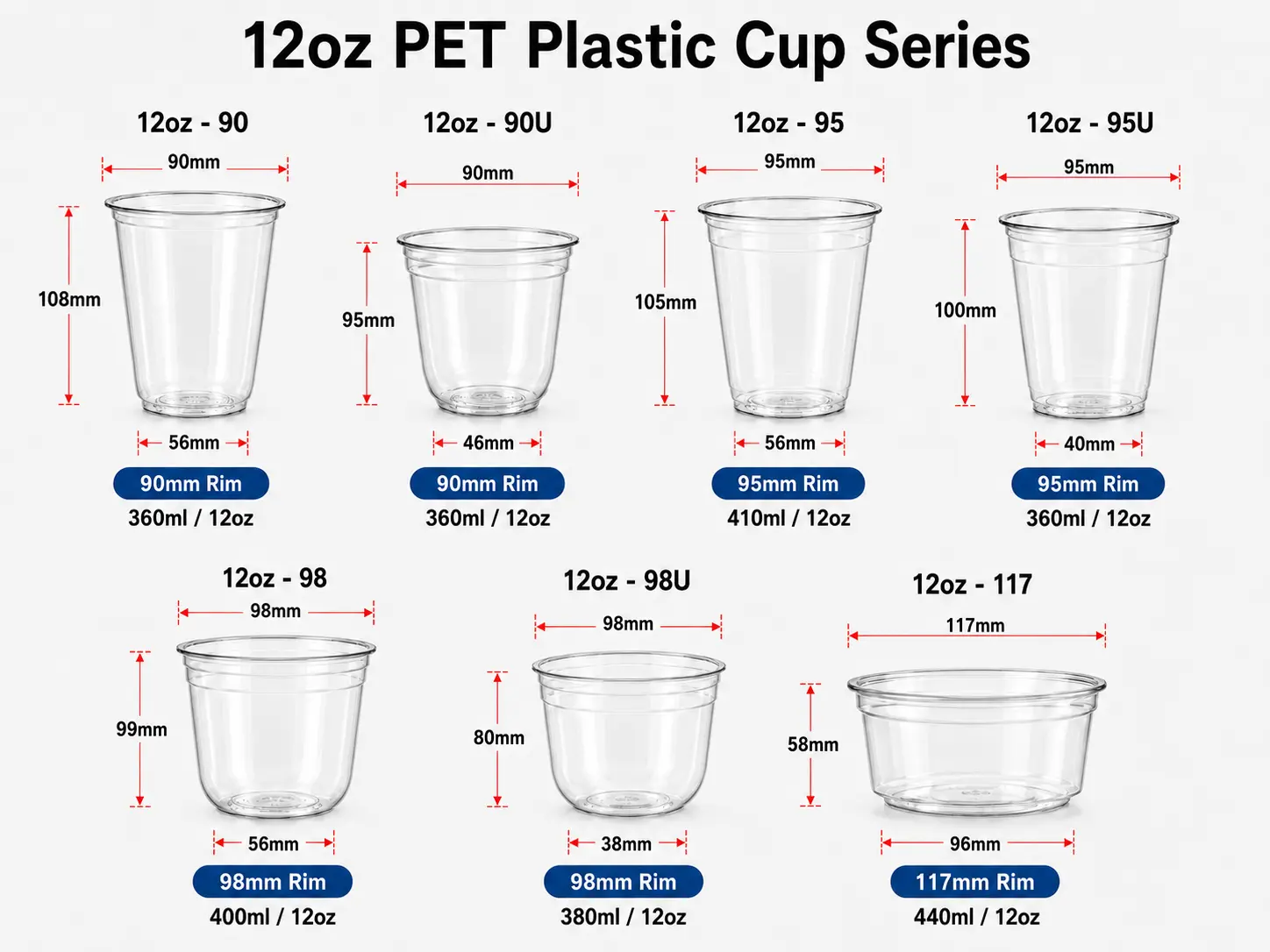
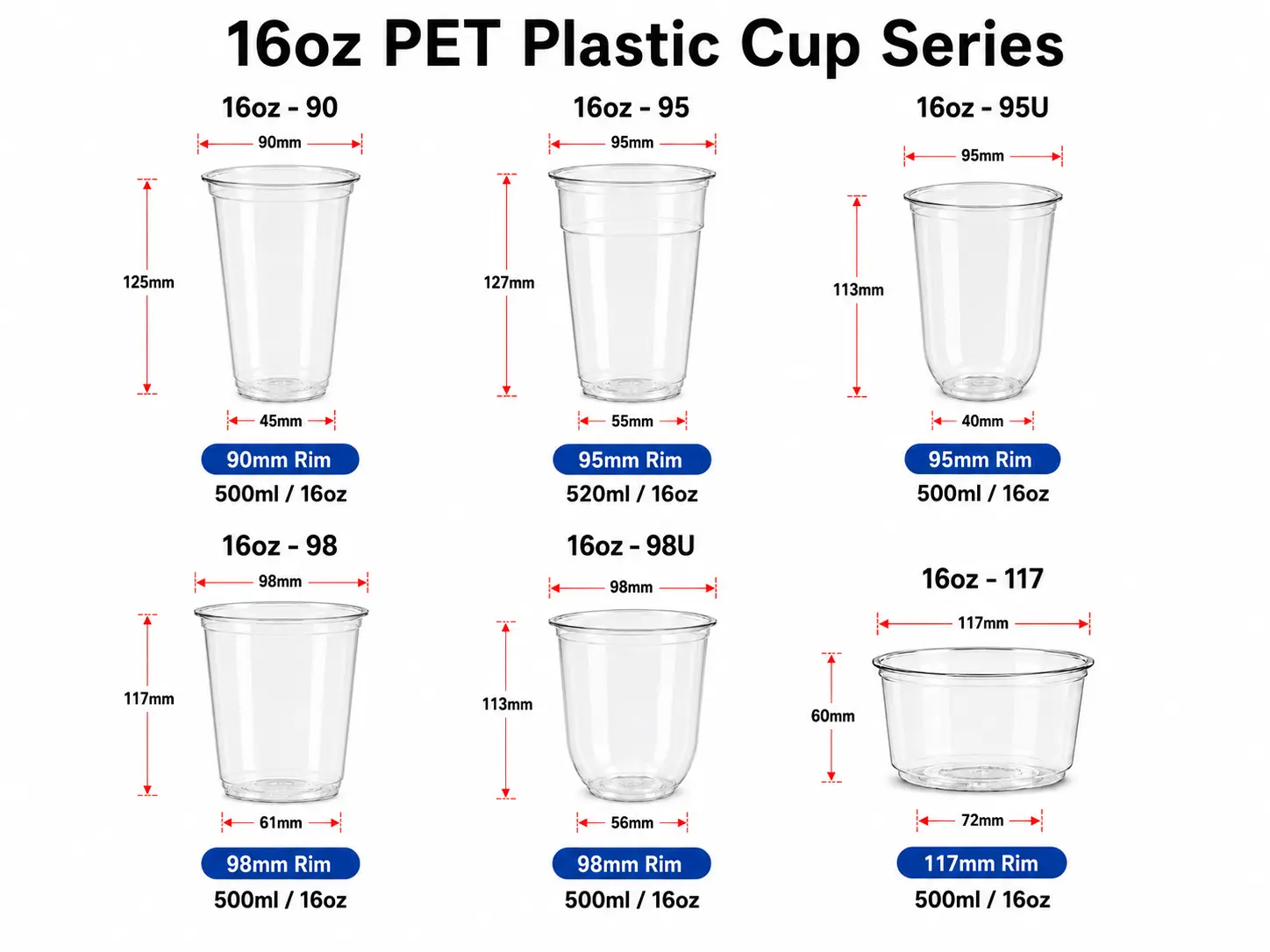
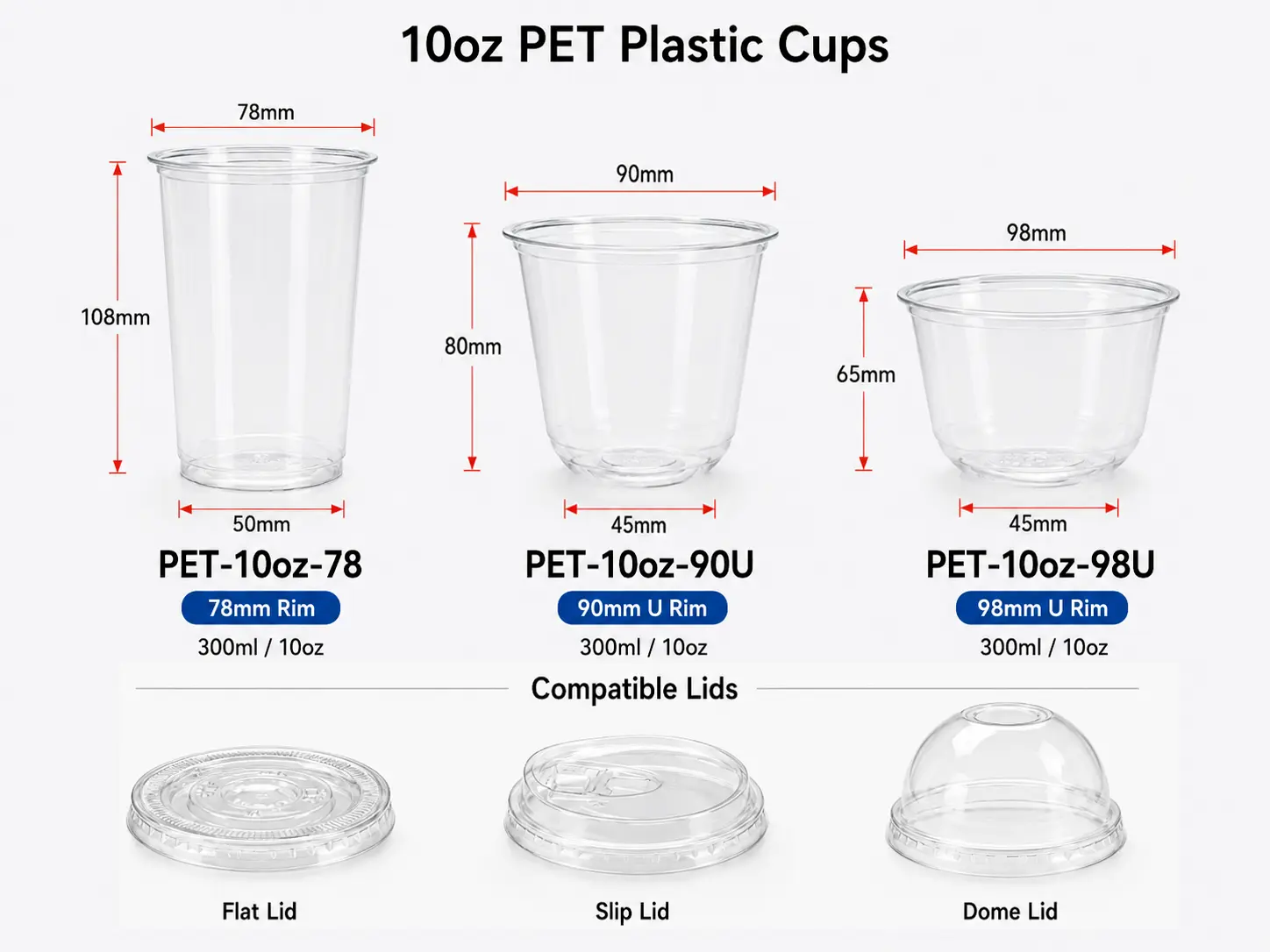
- Confirm capacity, top diameter, bottom diameter, height, wall construction, and rim geometry.
- Confirm filling, holding, storage, and service conditions for the exact product.
- Test the approved flat, dome, sip, or specialty lid on physical cup samples.
- Review clarity, haze, gloss, stress whitening, scratches, and beverage presentation.
- Approve printing for ink adhesion, opacity, color contrast, registration, and artwork position.
- Confirm carton quantity, nesting, denesting, export protection, and logistics assumptions.
- Verify food-contact and claim documents for the destination market and intended use.
Final Recommendation
Choose PET first when the verified application is cold-service and the buying case depends on high clarity, gloss, photography, and visible beverage ingredients. Evaluate PP when the exact finished-cup specification supports the required temperature and handling conditions and the customer accepts a more translucent visual result. Clarified PP should be judged from the actual cup, not from a generic assumption.
For an ordinary first check, use the molded resin mark, equal-light visual comparison, and controlled flex comparison. For a commercial approval, go further: verify the complete six-part packaging system. Before quotation or order approval, confirm the cup code, intended conditions, dimensions, rim and lid fit, print sample, packing, documents, and physical approval sample. That evidence—not the words PET or PP—should control the purchasing decision.
Frequently Asked Questions
Why do PET cups usually look clearer than PP cups?
Transparent PET cups are commonly formed with a largely amorphous structure, which limits visible-light scattering. PP is normally semi-crystalline, and boundaries within its crystalline morphology can create more haze. Clarified PP grades can reduce this difference, so buyers should compare actual finished cups.
How can a non-specialist tell PET and PP cups apart?
First check for a molded PET/PETE 1 or PP 5 mark. Then compare identical samples over black printed lines and gently compare sidewall flex. These are screening clues only. Supplier documentation or appropriate material analysis is needed when the identity must be certain.
Does PP automatically mean a cup is safe for hot drinks?
No. PP often has greater temperature tolerance than PET, but the finished cup must be approved for the exact beverage, filling temperature, contact time, lid condition, stacking load, storage, and consumer use. A resin property or melting point is not a finished-product use guarantee.
Can PET and PP cups with the same ounce capacity share lids?
Only when the top diameter, rim geometry, dimensional tolerances, and supplier-approved lid system match. Nominal capacity and resin type do not establish compatibility. Confirm drawings, cup and lid codes, assembled samples, retention, and leakage under the intended use condition.
What evidence should a buyer approve before ordering?
Approve the exact cup and lid specifications, intended service conditions, unprinted and printed samples, optical appearance, carton packing, food-contact documents, claim scope, and destination-market requirements. Keep a controlled approval sample and revision record for repeat orders.
References
- Di Lorenzo, M. L. et al. — Crystallization of Poly(ethylene terephthalate): A Review
- De Santis, F. et al. — Optical Properties of Polypropylene upon Recycling
- ASTM D1003-21 — Standard Test Method for Haze and Luminous Transmittance of Transparent Plastics
- ASTM International — Resin Identification Code Revised
- U.S. FDA — Food Types & Conditions of Use for Food Contact Substances
- European Union — Commission Regulation (EU) No 10/2011 on Plastic Materials and Articles Intended to Come into Contact with Food