
Quick Summary
- Choose PET or PP from the application requirements, not from the resin name alone.
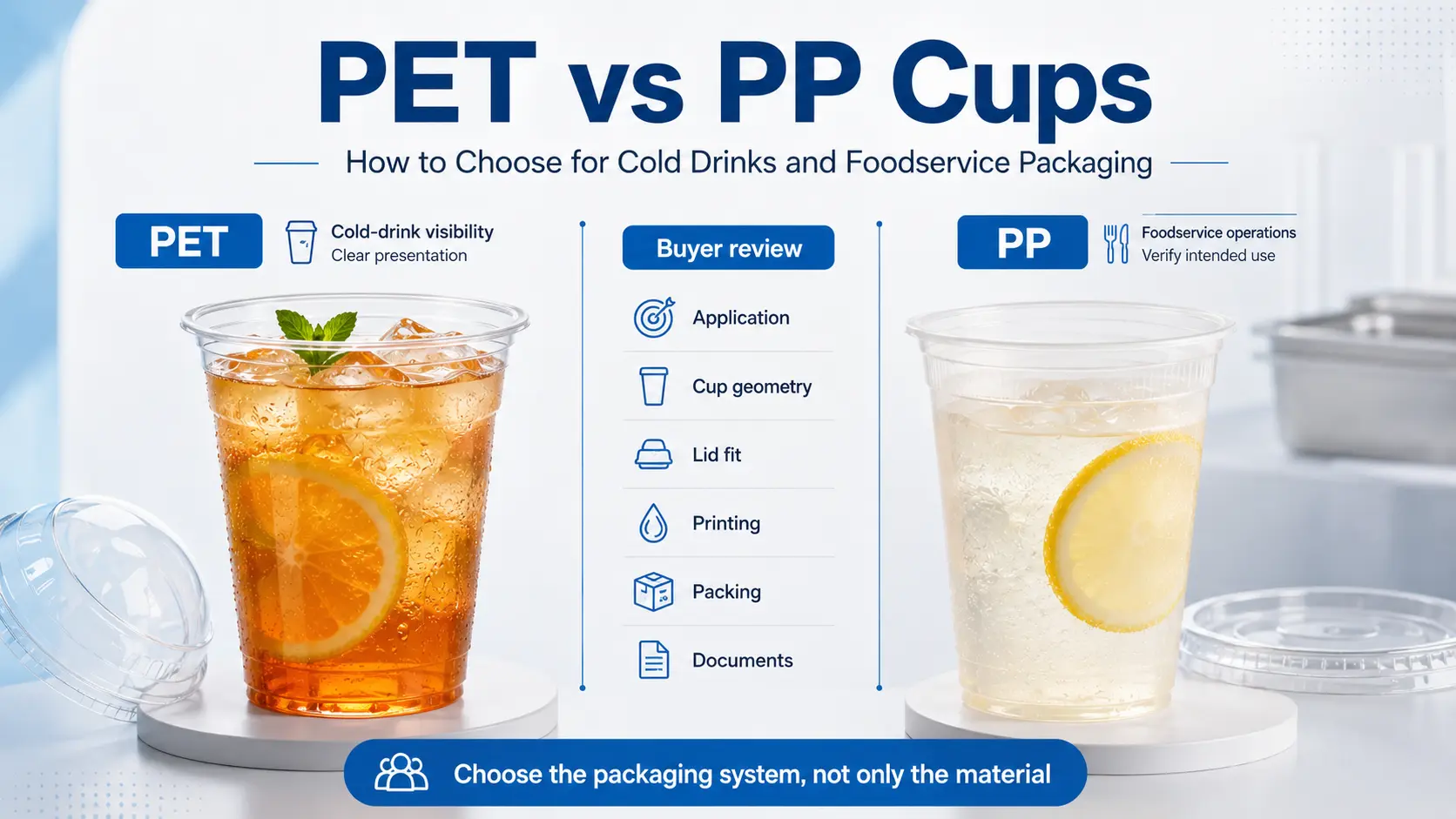
- PET is usually the starting point when cold-drink visibility and presentation are commercial priorities.
- PP may be evaluated when verified operating conditions require a different functional balance and lower clarity is acceptable.
- Professional buyers approve a complete cup, lid, print, packing, and documentation system.
- Final approval should follow specifications, matched samples, filled-use review, and supply-chain checks.
For cold drinks and foodservice packaging, PET is usually the stronger starting point when clear product presentation is commercially important, while PP may be evaluated when verified operating conditions require a different functional balance and lower clarity is acceptable. The final decision should not be made from the material name alone. Beverage brands, restaurants, importers, and distributors need to confirm the complete system: cup geometry, intended use, lid fit, artwork, packing, documentation, and supply continuity. This application guide focuses on how commercial buyers make that decision in practice rather than repeating the material-science comparison covered in a separate article.
Why Application Requirements Decide Between PET and PP Cups
A plastic cup performs two jobs at the same time. It contains a beverage or food product, and it shapes how that product is presented, handled, transported, and reordered. A material can look suitable in isolation yet become unsuitable when the lid system, filling workflow, customer experience, or export packing is considered.
The most reliable decision hierarchy starts with non-negotiable requirements. Buyers should first define the product, intended service conditions, closure method, and destination-market obligations. Visual preferences, printing options, and SKU efficiency come next. This order prevents an attractive cup from being approved before its operational fit is understood.
The Application-First Decision Rule
Do not ask which resin is better in general. Ask which verified cup-and-lid system supports the product, service environment, customer experience, and supply chain with the fewest unresolved risks. PET and PP are candidate materials; the approved commercial unit is the complete packaging system.
PET Cups for Cold Drinks: When Appearance Becomes Part of the Product
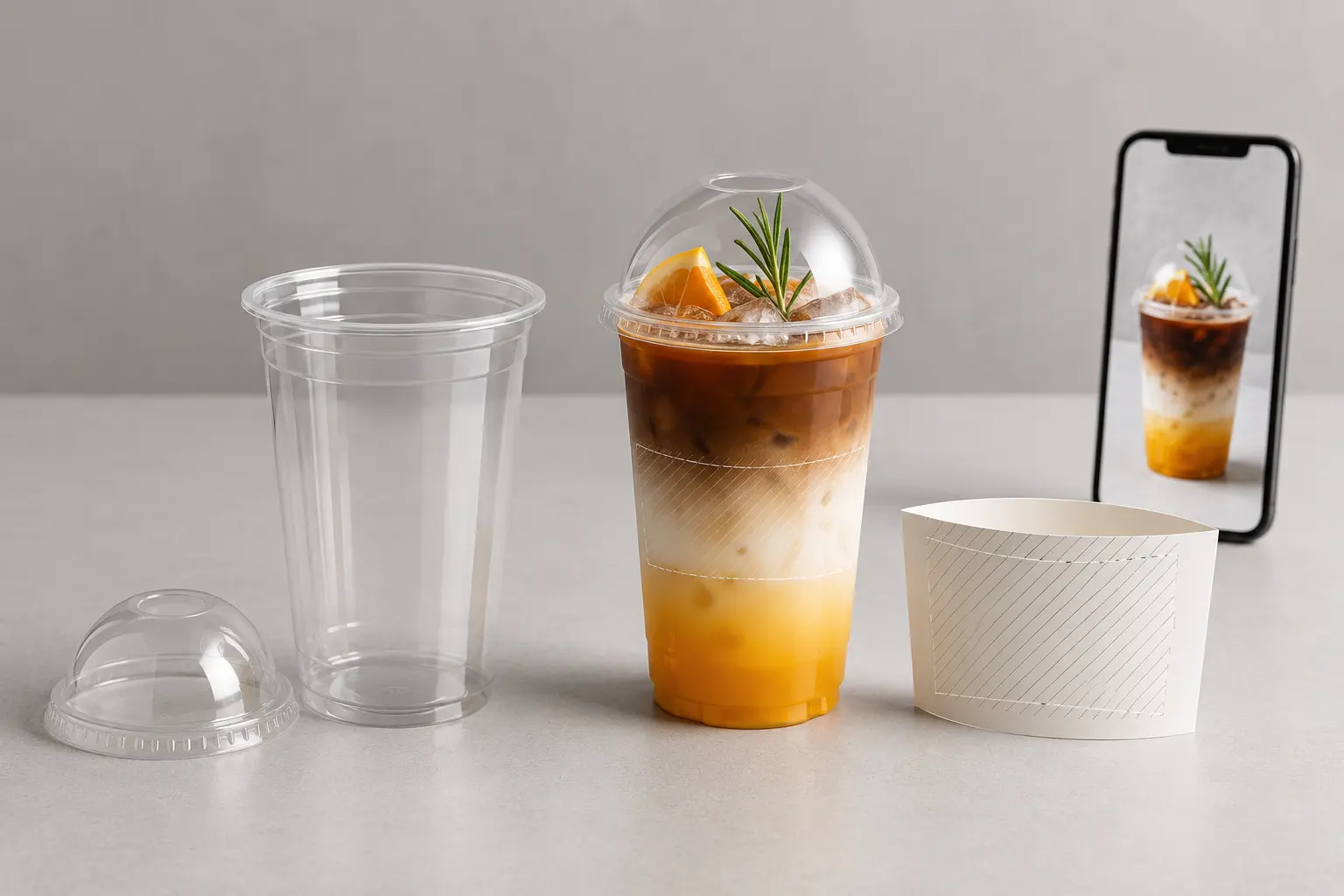
PET cups are often selected for chilled beverages because clear walls can make color, texture, layers, foam, fruit pieces, pearls, and toppings easier to see. For bubble tea, smoothies, iced coffee, fruit tea, juice, and premium takeaway drinks, visibility is not merely decorative. It can influence menu photography, counter display, delivery-app images, perceived freshness, and the customer’s confidence in what was prepared.
This creates a useful buyer question: does the cup help sell the drink? When the beverage itself is visually distinctive, the package becomes part of the merchandising system. Buyers should review the cup with the intended beverage rather than judging an empty sample under office lighting. Condensation, ice, dark liquids, milk-based drinks, toppings, and printed artwork can all change the final appearance.
What Buyers Should Approve for a PET Cold-Drink Program
Approve the exact cup profile and size range, not an abstract PET category. Confirm how the cup feels when filled, whether the base and sidewall support the intended handling, whether the rim matches the selected flat, dome, sip, or specialty lid, and whether the finished artwork preserves sufficient product visibility. A large opaque print area may reduce the commercial advantage of a clear cup, while a poorly positioned logo can be hidden by the hand, sleeve, condensation, or label.
PET should still be treated within the exact product specification and intended use. Clarity does not prove temperature suitability, food-contact status, lid compatibility, or performance under every distribution condition. Those items require product-level confirmation.
PP Cups for Foodservice: When Operational Requirements Carry More Weight
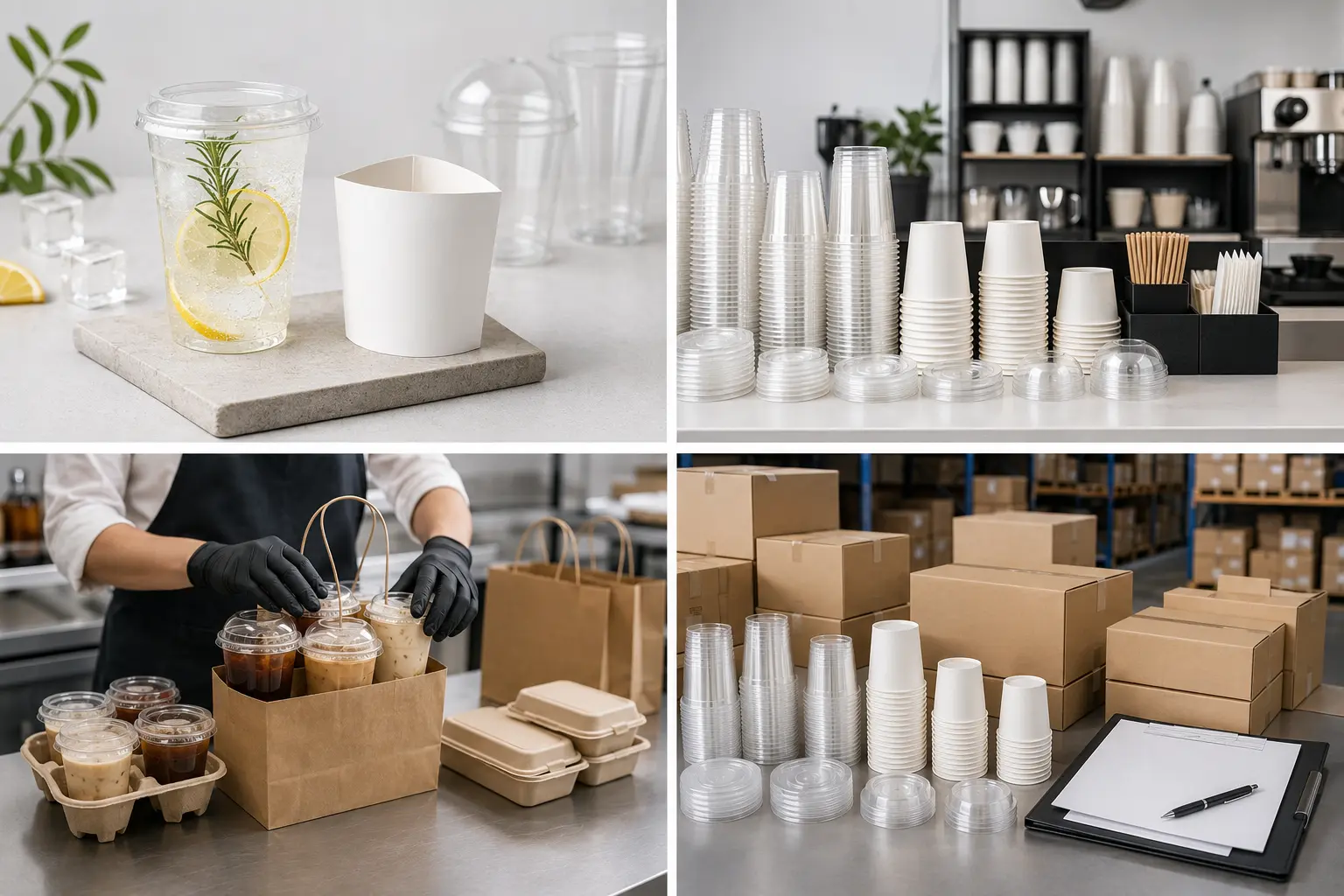
PP cups may be evaluated when a foodservice program places less value on glass-like clarity and more value on a different balance of handling and service requirements. The relevant scenarios can include restaurant takeaway, catering, institutional service, prepared-food applications, or beverage operations whose approved use conditions differ from a typical clear cold-drink program.
The critical word is verified. PP is broadly associated with greater heat resistance than PET, but that general tendency does not establish the permitted filling temperature, holding time, storage condition, microwave suitability, sealing process, or end use of a specific finished cup. Those limits depend on the exact resin formulation, wall construction, geometry, manufacturing process, and supporting documentation.
How to Evaluate PP in a Real Operation
Start with the workflow. Will staff fill and close cups rapidly during peak periods? Will the package be stacked, bagged, held, transported, or opened repeatedly? Does the cup need to remain easy to grip when wet? Is a translucent appearance acceptable for the menu and brand position? Does the operator need a specific lid style, sealing film, or accessory?
Then compare actual samples under the intended conditions. A theoretical material advantage has little commercial value if the chosen cup creates lid confusion, slower service, inconsistent stacking, or an appearance that weakens the product proposition. PP should therefore be positioned as a conditional application option, not as an automatic answer for every demanding foodservice use.
PET vs PP Recommendations by Business Model
The same beverage can lead to different packaging decisions depending on who operates, sells, imports, or distributes the cup. A brand owner may prioritize visual impact, while a distributor may prioritize a manageable SKU architecture and reliable repeat orders. The following scenarios show how the decision criteria change.
Beverage Brands and Franchise Chains
Begin with the brand promise. When drinks are differentiated by color, layers, toppings, or preparation, PET is often the first candidate because presentation supports customer recognition. The buyer should then standardize the approved cup profile, lid family, artwork position, and store-use instructions. A franchise system also needs repeatable specifications so different locations do not substitute visually similar cups that use different lids or change the finished appearance.
Cafés and Independent Drink Shops
Evaluate speed, storage, and menu flexibility. A smaller operator may benefit from using fewer verified rim systems across several cup capacities, but only where the supplier confirms compatibility. PET may suit highly visual chilled drinks; PP may be considered for other verified uses. The practical goal is to reduce staff errors without forcing every beverage into one material or one lid type.
Restaurants, Catering, and Institutional Foodservice
Operational reliability may outweigh display value. Review filling conditions, closure security, stacking, bagging, holding time, transport, and customer handling. Do not assume a cup is appropriate because another restaurant uses a similar-looking item. The approved product should match the actual menu, service sequence, and distribution route.
Importers, Distributors, and Wholesalers
Manage the portfolio as connected systems rather than isolated SKUs. Record the exact cup code, matching lid code, material, capacity, rim information, pack configuration, artwork status, and document set. A broader range can serve more customers, but an uncontrolled range increases inventory duplication and the risk that sales teams promise compatibility that has not been verified.
Portfolio design should also distinguish commercial convenience from proven interchangeability. Reducing the number of lid families can simplify sales training and inventory, but only after each cup-and-lid pairing has been documented. A distributor should be able to answer three questions without guesswork: which lid belongs to this cup, which approved artwork applies, and which packing specification should be reordered. That record is part of the product, not an administrative afterthought.
A Professional Buyer Decision Framework for PET and PP Cups
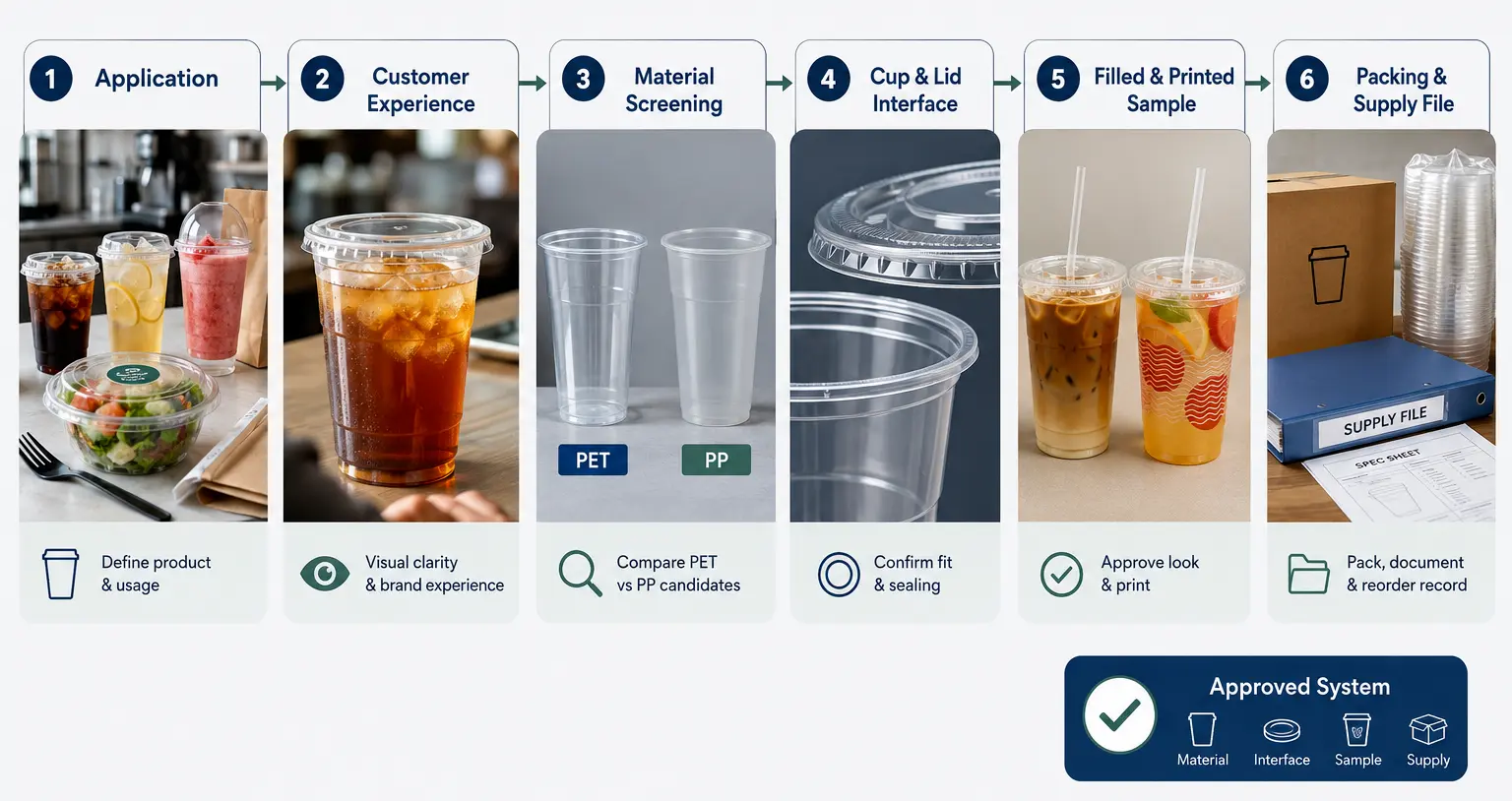
A strong sourcing process separates requirements from preferences and evidence from assumptions. The following sequence gives procurement teams, brand owners, and distributors a repeatable method for evaluating a new cup program.
- Define the product and service conditions. Record what will be filled, whether it is chilled or used under another specified condition, how long it may be held, and how customers will receive it.
- Define the customer experience. Decide whether visibility, premium appearance, easy handling, delivery convenience, or another feature is essential to the product proposition.
- Screen the material options. Use PET or PP as a starting hypothesis, then eliminate any option that cannot be supported by the exact product specification and intended use.
- Confirm the cup interface. Review geometry, capacity, rim profile, lid family, sealing method, accessories, and any equipment that contacts the package.
- Approve presentation and operation. Review filled samples, printed samples, staff handling, closure, stacking, bagging, and the way the package appears in the real sales channel.
- Close the supply-chain file. Confirm packing, quantity assumptions, shipping protection, product and lid codes, artwork version, document scope, and the approval sample used for repeat orders.
This process creates an evidence ladder: specification review first, physical fit review second, filled-use evaluation third, and packing or logistics review before final approval. Not every project requires the same test depth, but every important claim should be connected to an appropriate document, sample, or agreed verification step.
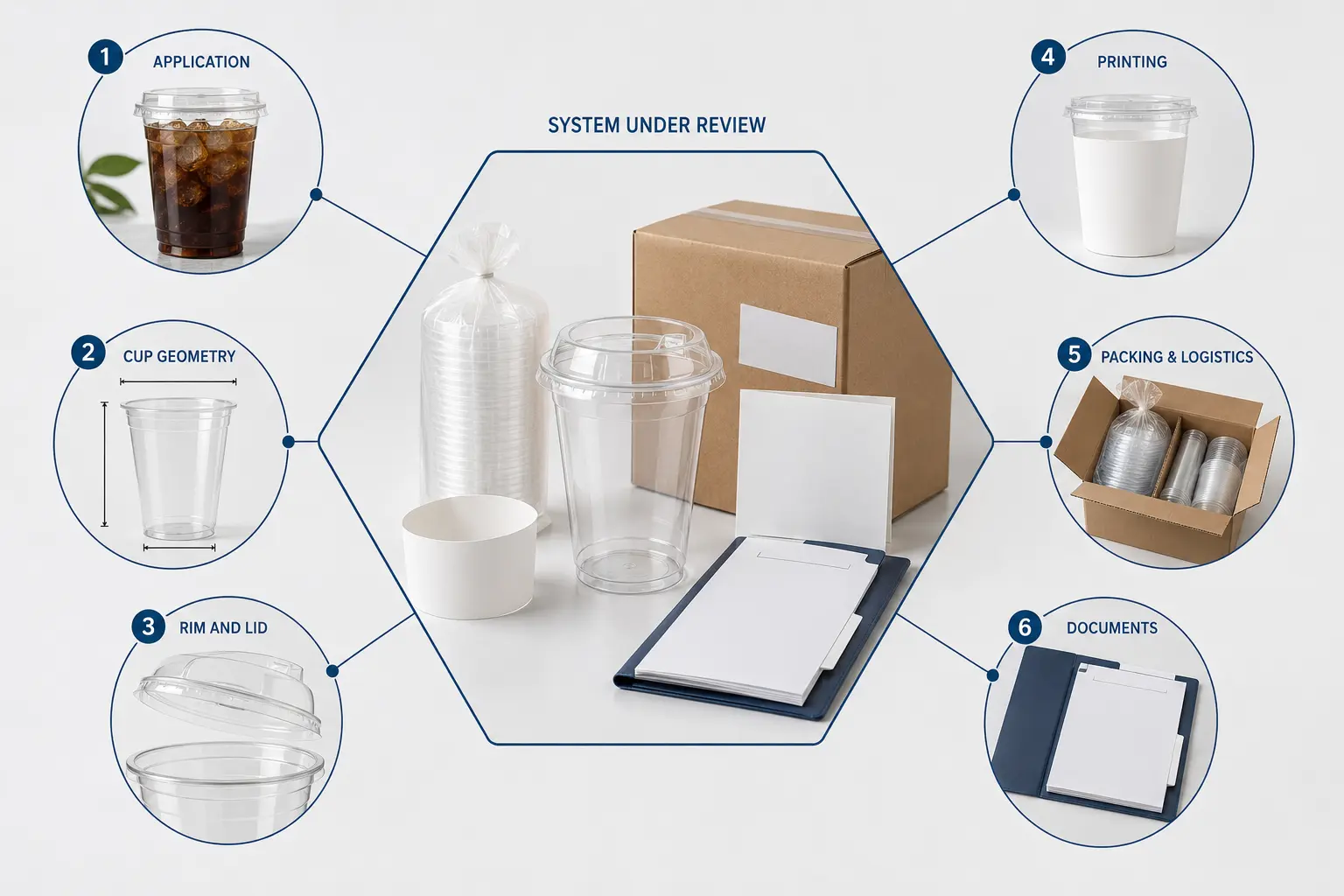
Approve the Complete Packaging System, Not a Material Name
The distinctive procurement principle of this guide is simple: professional buyers approve interfaces, not isolated items. The cup must interface with the beverage, lid, artwork, operator, carton, transport environment, documents, and customer. A failure at any one interface can erase the advantage of the selected resin.
| Approval area | What to review | Why it changes the decision | Evidence or confirmation |
|---|---|---|---|
| Application | Product type, intended service conditions, holding, customer use | Defines whether the candidate cup is suitable for the real operating context | Written use brief and product-specific supplier information |
| Cup geometry | Capacity, height, diameter, taper, base, wall construction, nesting | Affects handling, equipment fit, presentation, storage, and pack density | Specification, drawing, and physical sample |
| Rim and lid | Rim profile, matching lid code, closure style, physical fit | Similar capacity or diameter labels do not guarantee interchangeability | Matched cup-and-lid samples and documented pairing |
| Printing | Artwork area, opacity, color, registration, hand position, visibility | The final graphic can improve or reduce the intended presentation benefit | Production-representative printed sample or approved proof process |
| Packing and logistics | Pack count, sleeves, cartons, nesting, compression, handling route | Unit price alone does not reveal damage risk, storage demand, or freight efficiency | Confirmed packing specification and appropriate distribution review |
| Documents and claims | Material identity, food-contact evidence, intended-use scope, market needs | Evidence must match the exact article, application, and destination market | Current documents reviewed by the responsible buyer or compliance team |
Same Capacity Does Not Mean the Same System
Two cups described with the same nominal ounce or milliliter capacity can differ in rim geometry, height, base width, wall structure, nesting, and compatible lids. Treating them as substitutes without confirmation can create leakage, closure, inventory, or customer-service problems. Final approval should identify the exact cup and lid combination rather than relying on a size name.
Procurement Mistakes to Avoid and the Buyer Checklist
The most expensive sourcing errors often begin as reasonable shortcuts. A team chooses PET because it wants clarity but never evaluates the printed, filled cup. Another team chooses PP because of a general material assumption but never confirms the specific use condition. A distributor combines lids and cups from different suppliers because the nominal diameter appears equal. These decisions save time during comparison but transfer uncertainty into production, service, and repeat ordering.
Common Purchasing Errors
Avoid selecting by resin name alone, assuming all cups of one capacity share lids, comparing unit price without packing and logistics context, approving artwork only on a screen, or accepting documents that do not identify the relevant product and use. Another frequent risk is uncontrolled substitution: a visually similar cup is supplied on a repeat order without confirming that its geometry, lid pairing, or artwork position matches the approved sample.
Unit price should therefore be treated as one line in the decision, not the decision itself. The buyer also carries the consequences of carton utilization, storage space, duplicated lids, picking errors, damaged cups, rejected artwork, and emergency replacement orders. These factors do not justify inventing a universal cost formula, but they do justify comparing quotations on the same approved specification and pack basis. A cheaper cup that creates an additional lid family or uncertain repeat-order identity may increase landed operational risk rather than reduce it.
Repeat orders need change control. If the supplier proposes a different cup code, resin grade, lid source, print process, or packing arrangement, the buyer should decide which approvals must be reopened. A controlled substitution can be acceptable; an undocumented substitution turns the original sample approval into unreliable evidence.
Buyer Checklist
- Document the beverage or food application, service conditions, holding, and customer use.
- Confirm whether visual presentation is a requirement, a preference, or commercially irrelevant.
- Review the exact cup material, capacity, dimensions, geometry, and intended-use information.
- Approve the matching lid code and physical cup-and-lid fit; do not rely on capacity alone.
- Review filled and printed samples under realistic lighting, handling, and service conditions.
- Confirm pack count, sleeve and carton arrangement, storage impact, and shipping protection.
- Verify the document scope for the exact product, intended use, and destination market.
- Record the approved cup code, lid code, artwork version, packing specification, and reference sample.
Final Recommendation
For cold beverages whose color, layers, ingredients, or premium appearance help drive purchase, begin the evaluation with PET and verify the complete cold-service cup system. Where the operation has different verified service requirements and can accept a more translucent presentation, evaluate PP as a conditional alternative. Neither choice should be extended beyond the supporting specification and evidence for the exact finished product.
The strongest procurement decision is not “PET is better” or “PP is better.” It is: this approved packaging system is the best fit for this application. Before requesting a final quotation, approving a sample, or placing a bulk order, confirm the intended use, cup geometry, matched lid, printing result, packing, supply assumptions, product documentation, and destination-market requirements. That approach gives beverage brands and foodservice buyers a repeatable standard for selecting, introducing, and reordering cups without turning a general material preference into an uncontrolled operational risk.
Frequently Asked Questions
Which cup material should a beverage brand evaluate first?
Begin with the feature that is essential to the product. PET is often the first candidate when a chilled drink depends on clear visual presentation. PP may be considered where verified service requirements call for a different functional balance and lower clarity is acceptable. The final choice still requires product-specific specifications, matched lids, and realistic samples.
Are PET cups always the best option for cold drinks?
No. PET can be commercially valuable when customers need to see the beverage, but the best cup also depends on geometry, handling, closure, artwork, packing, and the supplier’s intended-use information. A highly clear cup is not automatically the best operational or sourcing fit for every cold-drink program.
Should restaurants choose PET or PP cups?
Restaurants should choose by menu and workflow. Review what is filled, how the package is closed, held, bagged, transported, and opened, plus whether product visibility matters to the customer. PP may be evaluated for some verified operational requirements, while PET may suit visible chilled products. Avoid a restaurant-wide material rule without product-level confirmation.
Why must cup and lid compatibility be approved together?
The lid closes against the exact rim geometry, not against the material name or nominal capacity. Two cups described with the same size can have different rim profiles or tolerances. Buyers should identify the approved cup code and lid code, review physical fit, and avoid assuming compatibility across product series or suppliers.
What should importers confirm before a bulk PET or PP cup order?
Confirm the application, exact cup and lid specifications, intended-use scope, artwork, printed and filled samples where relevant, pack count, carton arrangement, shipping protection, product codes, document scope, and destination-market requirements. Keep an approval record so repeat orders are compared with the same verified packaging system.
References
- U.S. FDA: Packaging & Food Contact Substances
- U.S. FDA: Inventory of Food Contact Substances Listed in 21 CFR
- EUR-Lex: Regulation (EC) No 1935/2004 on Food Contact Materials and Articles
- EUR-Lex: Commission Regulation (EU) No 10/2011 on Plastic Food Contact Materials
- ASTM D7611/D7611M-21: Resin Identification Coding for Plastic Manufactured Articles
- ASTM D4169-22: Performance Testing of Shipping Containers and Systems
- ISTA: Packaging Test Procedures and Distribution Simulation Overview