
Quick Summary
- There is no dependable cups-per-container figure based on ounce size alone. Calculate each SKU's cartons, CBM and gross weight from approved packing data, then verify the actual container loading arrangement.
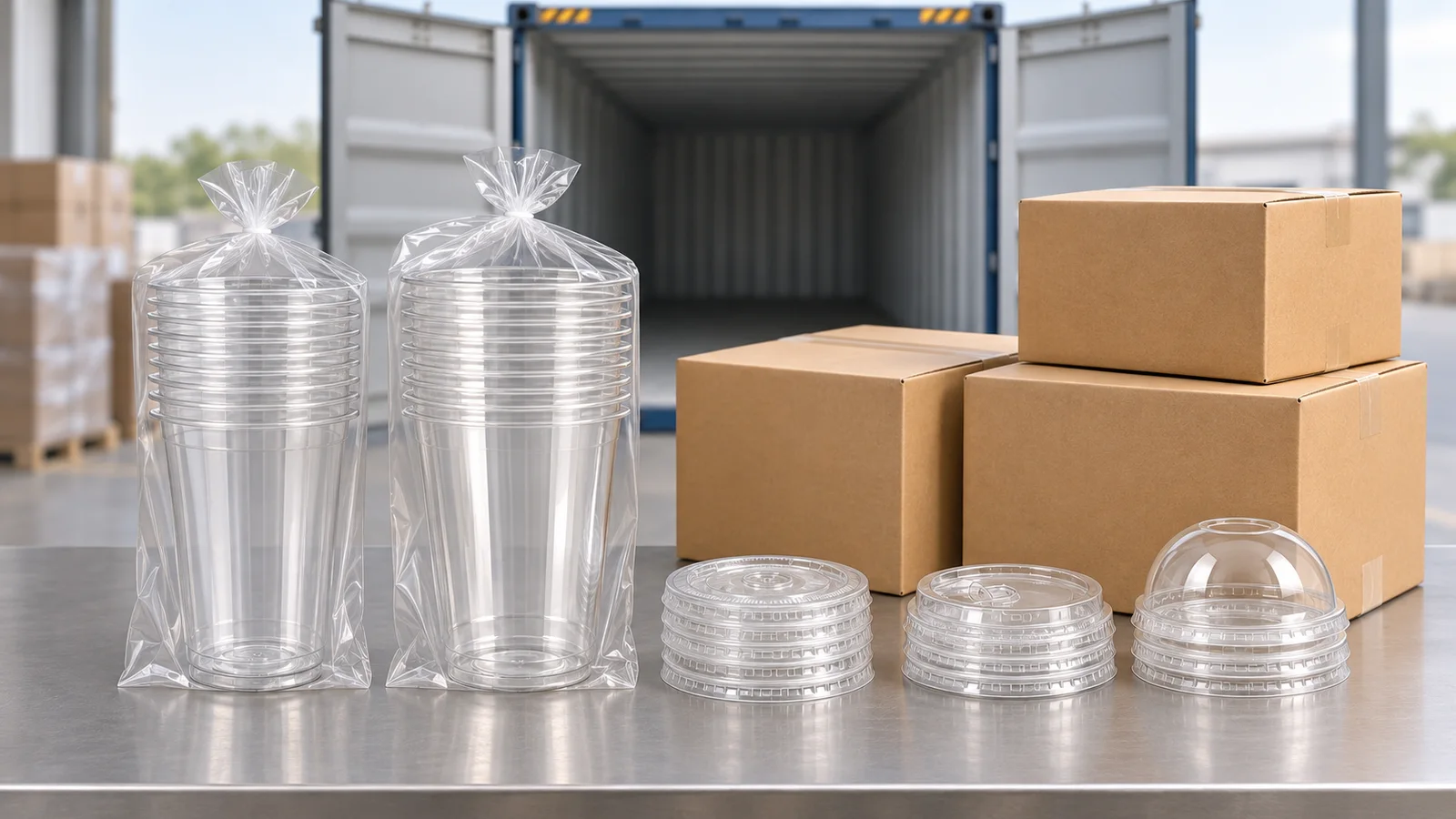
How many plastic cups fit in a 20ft or 40HQ container? There is no dependable cups-per-container figure based on ounce size alone. A usable estimate starts with the approved pieces per carton, carton outside dimensions, gross weight and the mix of cup and lid SKUs. Container volume then provides a planning boundary; a loading layout establishes what can actually ship.
Quick answer: Calculate the CBM and number of cartons for each SKU, check total cargo weight, then verify that the cartons can be arranged inside the specific container. A 20ft dry container is commonly described as having approximately 33.2 m³ of internal volume, while a 40ft high-cube (40HQ) has approximately 76.4 m³. Neither figure is a promise that all that space can be filled with cartons.[1]
For importers and distributors, the useful question is not simply “How many 16oz cups fit?” It is “How many cartons of this approved 16oz cup, its matching lids and our other sizes can we load without exceeding the space, weight and handling limits?” This guide shows how to answer that question before confirming a wholesale order.
Common PET Cup Loading Examples: 90mm Rim Where Available
The following PET size comparison provides practical 20ft and 40HQ planning estimates using published carton packing specifications. Click a cup size to view Bioleader Cups' corresponding product page. The 20ft figures use a cargo-volume allowance of 28–29 m³; the 40HQ figures use 68–69 m³.
Estimated cartons = whole cartons within the selected CBM allowance (rounded down). Estimated cups = cartons × pieces per carton. Figures are volume-based estimates; the actual loading layout and carton specification determine final quantities.
| PET cup size | Rim | Cups / carton | Carton L × W × H (cm) | Carton CBM | 20ft cartons (28–29 m³) | 20ft cups | 40HQ cartons (68–69 m³) | 40HQ cups |
|---|---|---|---|---|---|---|---|---|
| 6oz / 180ml | 78 mm | 1,000 | 40.5 × 32.5 × 39 | 0.05133375 | 545–564 | 545,000–564,000 | 1,324–1,344 | 1,324,000–1,344,000 |
| 7oz / 210ml | 78 mm | 1,000 | 41 × 33 × 37.5 | 0.0507375 | 551–571 | 551,000–571,000 | 1,340–1,359 | 1,340,000–1,359,000 |
| 9oz / 260ml | 90 mm | 1,000 | 46 × 37 × 41 | 0.069782 | 401–415 | 401,000–415,000 | 974–988 | 974,000–988,000 |
| 10oz / 300ml | 90 mm | 1,000 | 46 × 37 × 38 | 0.064676 | 432–448 | 432,000–448,000 | 1,051–1,066 | 1,051,000–1,066,000 |
| 12oz / 360ml | 90 mm | 1,000 | 46 × 36 × 46 | 0.076176 | 367–380 | 367,000–380,000 | 892–905 | 892,000–905,000 |
| 14oz / 460ml | 90 mm | 1,000 | 46 × 36 × 43 | 0.071208 | 393–407 | 393,000–407,000 | 954–968 | 954,000–968,000 |
| 16oz / 500ml | 90 mm | 1,000 | 46 × 36 × 50 | 0.082800 | 338–350 | 338,000–350,000 | 821–833 | 821,000–833,000 |
| 18oz / 520ml reference | 90 mm | 1,000 | 46 × 36 × 51 | 0.084456 | 331–343 | 331,000–343,000 | 805–816 | 805,000–816,000 |
| 20oz / 600ml | 90 mm | 1,000 | 46 × 36 × 55 | 0.091080 | 307–318 | 307,000–318,000 | 746–757 | 746,000–757,000 |
| 24oz / 660ml | 90 mm | 1,000 | 46 × 36 × 61 | 0.101016 | 277–287 | 277,000–287,000 | 673–683 | 673,000–683,000 |
Reference calculations, not guaranteed container quantities. The 6oz and 7oz carton packs follow Bioleader product listings; the 9oz–24oz carton dimensions are comparable published 90mm industry packing examples, not confirmed Bioleader export packs. The 18oz reference is 520ml; Bioleader's 18oz product range is 560ml.
For Bioleader's own products, use the PET cup range to select the actual size, shape and rim, and recalculate the table using its approved export carton dimensions before booking a container. Standard-size examples are valuable for budgeting, but they are not a substitute for a product-specific packing sheet.
Bioleader Cups' Practical Container Loading Experience: PET vs Insulated PLA
Nominal container capacity is larger than the cargo CBM typically achieved in a finished cup shipment. The following figures are Bioleader Cups' own operational planning experience supplied for this article, not published shipping-line container capacities and not a universal guarantee for every cup size or packing revision.
| Product and packing basis | 20ft practical cargo volume | 40HQ practical cargo volume | Main planning distinction |
|---|---|---|---|
| Standard export-packed PET cups | 28–29 m³ | 68–69 m³ | Ordinary PET export cartons without the additional PLA insulation system |
| PLA clear cups with thermal-protection packing | 25–26 m³ | 63–66 m³ | Thermal bag/liner within cartons and the container-level insulating arrangement reduce usable loading space |
These values are working cargo-volume ranges for the described packing approaches, not the legal gross capacity of a container. PET cup loads can be planned around 28–29 m³ for a 20ft and 68–69 m³ for a 40HQ. With Bioleader's specified PLA thermal-protection solution, the practical planning allowance is lower: about 25–26 m³ for a 20ft and 63–66 m³ for a 40HQ. The final plan also depends on carton orientation, carton strength, weight, palletization, and the mix of cups and lids.
Why the PLA Insulation System Reduces the Loading Allowance
Bioleader's PLA export protection may include insulated thermal bags or liners within cartons and a larger insulating liner inside the container. This added system occupies space and changes the packing arrangement. It is designed to help manage external heat exposure during transport; it is not a guarantee of a particular cargo temperature. Routes, season, transit conditions and the exact protection method still need review.

Bioleader Cups' PLA insulated export packaging solution. Extra thermal protection helps explain why the planning CBM for PLA is lower than for standard PET loads.
Do not use the PET table for insulated PLA: a PET calculation based on 28–29 m³ or 68–69 m³ should not be transferred to a PLA order. Start with the 25–26 m³ or 63–66 m³ PLA planning range, then use the actual insulated carton size and approved container lining arrangement to calculate the final SKU quantities. These are material/packing-specific planning ranges, not a fixed percentage of container capacity.
Why Cup Size Alone Cannot Predict Container Quantity
A label such as 12oz, 16oz or 24oz describes a nominal serving class, not the cube of a shipping carton. Two cups in the same size class can have different heights, rim diameters, body profiles and nesting behavior. Those differences change how stacks are sleeved, how sleeves sit in cartons and how many cartons can be arranged in a container.
Same Ounce Size, Different Carton Packs
Consider the regular and wide-mouth formats shown within Bioleader Cups' 16oz PET cup product family. They belong to the same nominal size category but are not one interchangeable packing specification. The product listing can help identify the variant; the shipment calculation still needs a packing sheet for the exact SKU and revision being ordered.
Likewise, a 24oz PET cup should not be assigned a carton quantity merely by scaling up a 16oz figure. An altered cup profile, sleeve count or carton footprint can change the result independently of capacity.
Nesting and Packing Affect Shipment Volume
Disposable cups are generally stacked for shipment. The usable stack height depends on the specific cup construction and nesting geometry. Carton space is also occupied by packaging, clearances and the arrangement of sleeves. For that reason, an individual cup's height multiplied by the cup count is not a carton-volume calculation.
The first decision is to lock the selected cup and its approved packing. If cup size or rim options are still open, use the PET cup sizes and dimensions guide before estimating freight.
Avoid this shortcut: “Both products are 16oz, so they must fit the same number of pieces in a 40HQ.” Nominal capacity does not establish pieces per carton or cartons per container.
What Packing Information Do Buyers Need Before Calculating?
Ask for a SKU-level packing schedule rather than a single container capacity claim. The schedule should refer to the actual cup or lid being purchased, not a generic catalogue illustration.
| Packing field | What it controls | Buyer verification |
|---|---|---|
| Exact SKU / product variant | Which cup or lid the data describes | Match the quotation and approved sample |
| Pieces per sleeve | Unit arrangement within a carton | Confirm counting unit and sleeve type |
| Sleeves per carton | Carton piece count | Cross-check pieces per carton |
| Pieces per carton | Conversion from cartons to saleable pieces | Confirm whether cups and lids are separate |
| Carton outside length, width, height | CBM and physical fit in the container | Record units and outside dimensions |
| Carton gross weight | Shipment mass and stacking review | Use the packed, not empty, carton weight |
| Pallets / loading method | Available floor area and stacking height | Specify floor-loaded or palletized |
| Packing revision and carton marking | Identification across a mixed shipment | Ensure all records match the order |
Confirm Sleeve, Carton and Piece Counts
The basic cross-check is pieces per sleeve × sleeves per carton = pieces per carton. If the supplier describes a special packing method, obtain the actual carton count instead of assuming this relationship. Lids should have their own SKU and carton quantity; a cup carton and a lid carton are not equivalent units.
Record Outside Dimensions and Gross Weight
Use outside carton dimensions in centimeters or meters, not cup dimensions or carton internal dimensions. Record gross weight per packed carton. For palletized shipments, pallet quantity, footprint, height and weight must also be included in the loading review.
Cargo Gross Weight Is Not the Container's VGM
The packed-carton total is the mass of the goods and their cartons. It is not the verified gross mass (VGM) of the packed container. The empty container has its own tare mass; pallets, dunnage and securing materials also contribute to the loaded unit's total mass.
IMO describes two verification routes: weighing the packed container, or weighing the packages, cargo, pallets and securing materials and adding the container tare using a certified method approved by the relevant competent authority. For shipments covered by the SOLAS requirements, the shipper is responsible for providing the VGM. Agree the weighing arrangement, responsible party and submission deadline with the forwarder; a planning worksheet is not a verified weighing record.[4]
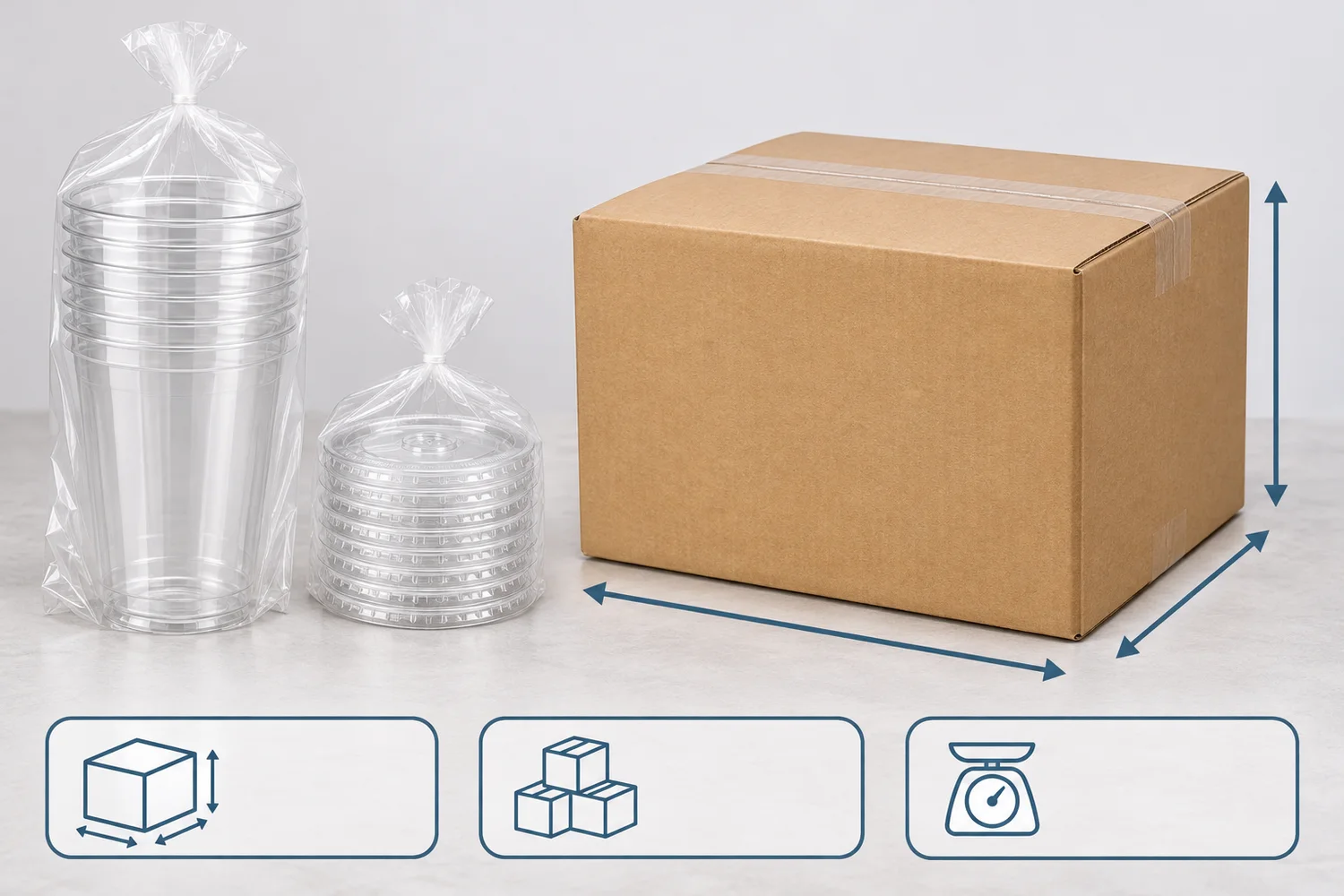
Confirm carton outside dimensions, piece counts and gross weights for each approved cup or lid SKU.
When pre-shipment packing is checked against the order, the plastic cup quality control guide provides the related inspection logic. Container planning uses that approved packing information; it should not replace the packing approval step.
How to Calculate Plastic Cup Carton CBM
CBM means cubic meters. It describes volume, not the number of saleable cups. Calculate it carton by carton, then use the relevant pieces-per-carton figure to convert between shipping units and product quantity.
- Measure the carton: record its outside length, width and height in centimeters.
- Calculate carton CBM: length × width × height ÷ 1,000,000.
- Find the required cartons: ordered pieces ÷ pieces per carton, then round up to whole cartons if partial cartons are not permitted.
- Calculate shipment CBM: cartons × CBM per carton; add all SKUs separately.
- Calculate cargo gross weight: cartons × packed gross weight per carton, plus pallets and other loading materials where applicable.
Carton CBM formula
Carton CBM = L (cm) × W (cm) × H (cm) ÷ 1,000,000
Shipment formulas
Total CBM = Σ [carton quantity × CBM per carton]
Total pieces of a given SKU = carton quantity × pieces per carton
Total carton gross weight = Σ [carton quantity × gross weight per carton]
Worked Example: A Single-SKU Shipment
The figures below are illustrative assumptions only. They are not Bioleader Cups' approved packing specifications or a quoted container loading capacity.
| Illustrative input | Assumed value | Calculation |
|---|---|---|
| Carton dimensions | 60 × 40 × 50 cm | 60 × 40 × 50 / 1,000,000 = 0.12 CBM |
| Pieces per carton | 500 cups | Assumption, not a supplier specification |
| Planned cup quantity | 60,000 cups | 60,000 / 500 = 120 cartons |
| Total carton volume | 14.4 CBM | 120 × 0.12 |
| Gross weight per carton | 10 kg | 120 × 10 = 1,200 kg of cartons |
The result is 120 cartons, 14.4 CBM and 1,200 kg of packed cartons under these assumptions. It does not say that a 20ft container will accept any other number of cartons, nor does it account for pallets, load securing or the actual arrangement. Its purpose is to show how to calculate an order before requesting a loading layout.
Why a CBM Result Is Not a Loading Promise
Dividing a container's published internal volume by a carton CBM gives a volume-only mathematical quotient. It ignores whole-carton geometry, gaps between rows, permitted stacking, door clearance and weight distribution. Treat it as a rough screening figure, not an approved cartons-per-container value.
20ft vs 40HQ: How Much Loading Space Is Available?
A standard 20ft dry container and a 40ft high-cube dry container are different in both length and internal height. Commonly published reference capacities are shown below. Exact measurements and permitted payload can vary by equipment owner, unit and transport route.
| Planning reference | 20ft standard dry | 40ft high cube (40HQ) |
|---|---|---|
| Typical nominal internal volume | Approximately 33.2 m³ | Approximately 76.4 m³ |
| Container type | Standard-height dry freight | High-cube dry freight |
| Potential advantage | Smaller overall shipment commitment | More internal space for approved carton loads |
| Before choosing | Check floor layout, height, weight and freight economics | Check floor layout, height, weight and freight economics |
These are nominal container-space references, not recommended usable CBM allowances. No fixed utilization percentage works for every carton size or loading method. Check the exact container specification with the carrier or freight forwarder before finalizing a plan.
For the values above, Maersk's equipment guide lists 33.2 m³ for a 20ft standard dry container and 76.4 m³ for a 40ft high cube. Hapag-Lloyd's specification also lists 40ft high-cube variants at 76.3 m³. These carrier examples explain why a generic container label is not an equipment-specific loading approval.[1][2]
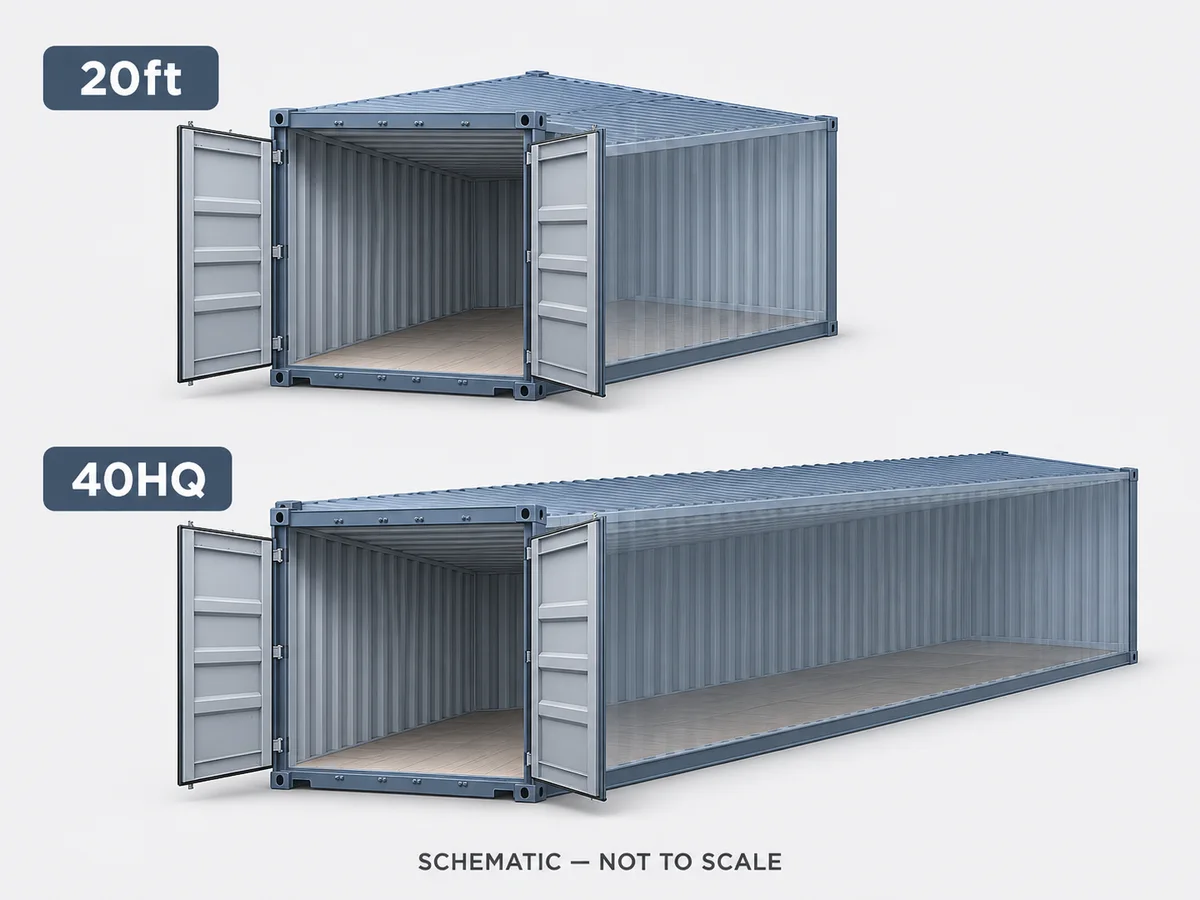
Nominal container volume is a planning reference; actual equipment and loading constraints still apply.
Physical Loading Constraints That CBM Alone Misses
A carton may fit the total cubic volume yet fail a practical loading check. Dimensions must allow each carton or pallet to pass through the door, fit into the internal footprint, stack within an agreed height and remain stable during handling. Heavy cartons cannot simply be placed on lighter or easily deformed packaging without review.
Check Whole-Carton Geometry, Not Only Total CBM
For a simple rectangular grid in one fixed carton orientation, a first geometric check is floor(L / l) × floor(W / w) × floor(H / h), using the container's internal dimensions L, W and H and the carton's outside dimensions l, w and h in the same units. The floor function means rounding each result down to a whole carton. Repeat for permitted orientations rather than rounding up fractional cartons.
This is a screening calculation for one uniform arrangement, not a validated loading capacity. Door access, carton strength, pallet height, securing space and handling can reduce the result; mixed orientations need their own layout. Ask for an actual row-and-layer plan before converting the geometric count into an order quantity.
Floor-Loaded vs Palletized Cartons
Floor loading can use space differently from palletized loading, while pallets can simplify handling and receiving. Neither method is universally preferable. The buyer should specify the destination warehouse's unloading requirements before comparing the two loading plans.
For a freight-cost comparison, connect the approved carton volume to the shipment terms and destination rather than assuming a larger container always means a lower landed cost. The bulk plastic cup pricing guide explains why product price, packing and freight must be compared on the same basis.
How to Plan a Mixed Container of PET Cups, PLA Cups and Lids
A mixed shipment needs more than one total cup count. Every cup variant and lid must have its own carton data and order line. This matters particularly to distributors carrying several sizes or supplying both standard clear PET cold cups and selected PLA cold-cup programs. Before combining the shipment, review MOQ requirements for mixed cup orders by size and artwork.
Begin with the PET cup range or PLA cup range to identify the exact commercial product families. The product selection should come first; carton and loading calculations should follow the selected SKUs.
An Illustrative Mixed-Load Worksheet
Use the following as a layout template only. The SKUs and quantities are placeholders for buyer planning, not an actual Bioleader shipping record.
| Item | Cartons | CBM/carton | Total CBM | Piece quantity |
|---|---|---|---|---|
| PET cup SKU A | 80 | 0.12 | 9.60 | 80 × approved pcs/carton |
| PLA cup SKU B | 30 | 0.14 | 4.20 | 30 × approved pcs/carton |
| Matching lid SKU C | 40 | 0.09 | 3.60 | 40 × approved pcs/carton |
| Illustrative total | 150 | — | 17.40 | Keep cup and lid totals separate |
The combined carton volume in this example is 17.40 CBM, but that result alone cannot validate the stacking layout. It also says nothing about whether the number of lids matches the number of cups requiring lids. Cup and lid counts must be reconciled by approved matching SKU, not by a general label such as “16oz lid.”
Match Lid Quantities to Approved Cup SKUs
Record the lid style, rim family, exact approved lid identifier and order quantity against each cup line. A shared nominal diameter does not prove lid fit. Where products are still being selected, consult the cup and lid compatibility guide before treating the shipment as a matched system.
Identify Material-Specific Transport Needs
For a PLA program, ask the supplier to confirm the actual product's storage and transportation instructions. Evaluate heat exposure, storage duration and handling controls against the approved product requirements; do not assume PET and PLA cartons automatically share identical handling limits. No universal temperature guarantee should be inferred from the material name.
For clear PLA cold cups, the PLA cup storage and shipping guide explains heat-related deformation and the packaging review that belongs alongside the loading plan.
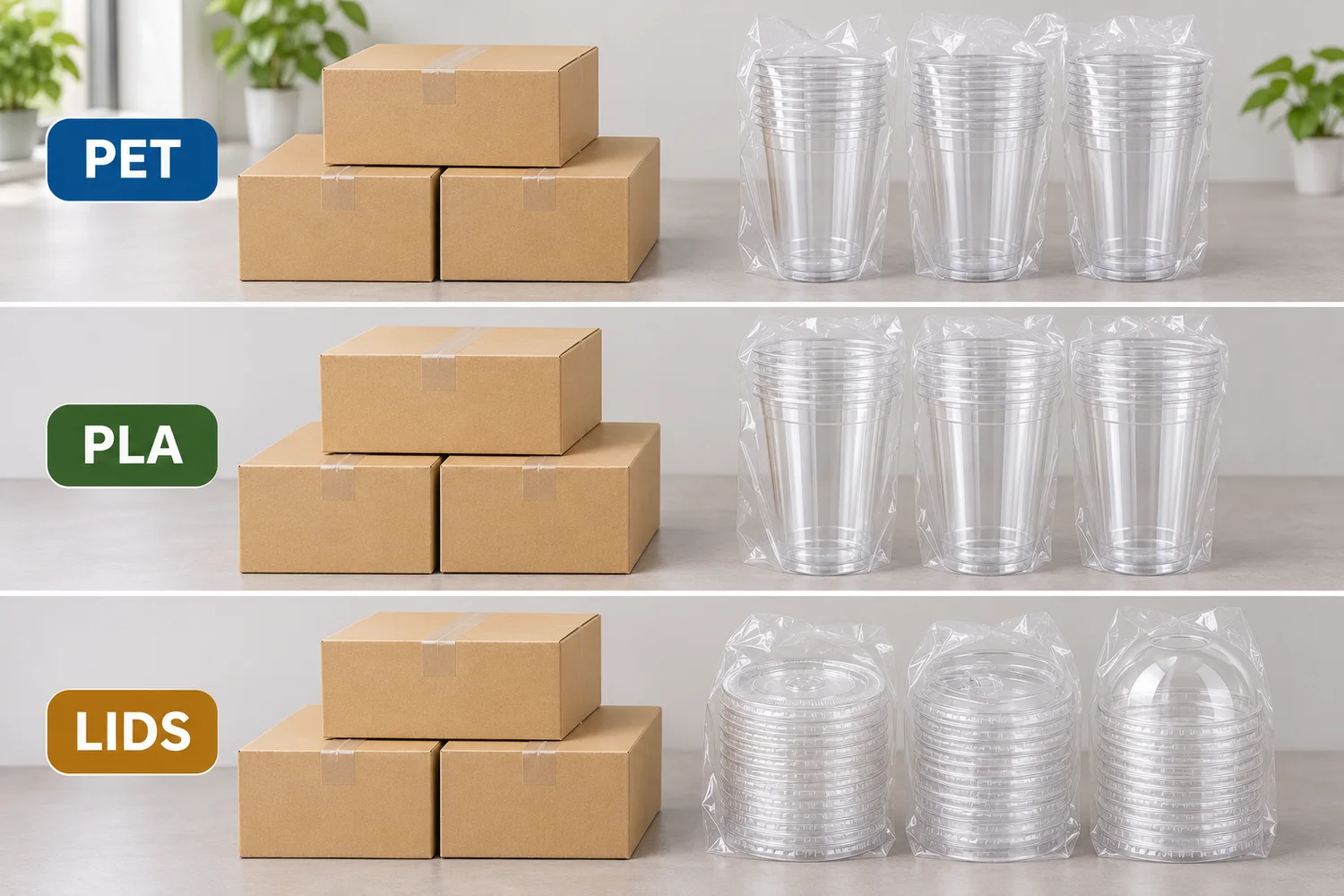
Track each cup and lid SKU separately before reviewing the combined CBM, weight and loading arrangement.
Common Container Loading Mistakes Plastic Cup Buyers Should Avoid
| Mistake | Why the estimate fails | Better control |
|---|---|---|
| Calculating from 16oz or 24oz alone | Ounce size does not describe the shipping carton | Request exact SKU packing data |
| Using internal carton measurements | Understates carton outer volume | Use packed carton outside L × W × H |
| Using all nominal container CBM as cargo space | Ignores arrangement, gaps and handling limits | Request a loading sketch or verified plan |
| Combining lids and cups into one piece total | Conceals shortages or incorrect component ratios | Track each approved SKU separately |
| Reusing old carton data after a packing change | Changes volume, quantity and weight assumptions | Control packing revisions and recalculate |
| Ignoring destination unloading rules | Shipment may arrive in a form the warehouse cannot handle | Agree on palletization and unloading method in advance |
A container plan is an order-control document, not a substitute for cargo securing instructions, actual equipment limits or the forwarder's transport assessment.
The IMO/ILO/UNECE CTU Code provides international good-practice guidance on packing and securing cargo transport units across sea and land transport. Use it as a reference for the packing and receiving teams, alongside the equipment limits and the shipment's securing plan. A CBM spreadsheet alone does not address the complete packing task.[3]
What to Send Bioleader Cups for a Container Loading Estimate
Once the cup and lid selections are stable, a useful loading request identifies exactly what needs to be shipped and how the goods will be received. Buyers preparing their first international order can use the plastic cup sourcing guide for the surrounding supplier-approval process.
- Product list: PET or PLA, exact cup and lid references, desired sizes and product variations.
- Order quantities: separate pieces required for every cup and lid SKU; identify acceptable overages or full-carton rounding.
- Packing basis: the latest pieces per carton, carton dimensions and gross weight; flag any information awaiting confirmation.
- Shipment requirements: destination, container preference, palletized or floor-loaded handling and receiving constraints.
- Approval request: ask for a revised SKU-level packing list, total CBM/weight and proposed loading layout before treating the capacity as final.
If custom print or private-label cartons are included, identify the approved artwork and packing revision as additional order records. The custom printed cups page is the relevant commercial route only when branding forms part of the actual project.
Buyer Checklist: Before Approving a Container Load
- Exact cup and lid SKUs match the quotation, approved samples and order list.
- Every SKU has a confirmed pieces-per-carton figure and packing revision.
- Carton outside dimensions are recorded in consistent units.
- Carton gross weights and any pallet weights are included.
- The container tare and the VGM weighing and submission arrangements are recorded separately from the carton-only estimate.
- CBM totals and cup or lid piece totals have been calculated separately by SKU.
- Door opening, carton orientation, stacking height and load stability have been reviewed.
- The container's actual equipment limits and route constraints have been checked with the forwarder.
- Mixed cup and lid quantities are reconciled against the approved compatibility list.
- Destination receiving requirements and shipment marking are agreed.
- A proposed loading layout and the final packing list are ready for approval.
Final Recommendation
Do not buy a “20ft load of 16oz cups” or a “40HQ load of plastic cups” on the basis of one headline piece count. Choose the exact cups and lids, confirm their packing, calculate carton CBM and gross weight by SKU, then have the loading arrangement checked. Container volume sets a boundary; approved carton specifications and a feasible layout determine the shipment.
For a Bioleader Cups quotation, send the selected products, quantities, packing requirements, destination and preferred handling method through the contact page. Ask for the specific packing and loading proposal rather than assuming that the illustrative figures in this guide apply to your order.
Frequently Asked Questions
How many plastic cups can fit in a 20ft container?
There is no reliable universal number. A 20ft standard dry container has roughly 33.2 m³ of nominal internal volume, but actual carton quantity depends on the exact cup SKU, pieces per carton, carton outside dimensions, gross weight, loading method and physical arrangement. Request a SKU-specific packing schedule and loading plan.
How many plastic cups can fit in a 40HQ container?
A typical 40ft high-cube dry container has approximately 76.4 m³ of nominal internal volume, not a fixed number of plastic cups. Calculate the cartons and CBM for the approved cup packing, then check stacking, weight, door clearance and the loading arrangement. The count must be confirmed for the actual products and container.
How do I calculate CBM for cartons of disposable plastic cups?
Multiply the packed carton's outside length, width and height in centimeters, then divide by 1,000,000. Multiply the result by the number of cartons to obtain total carton CBM. Calculate each SKU separately and add the totals; remember that CBM alone does not prove the cartons can be physically loaded.
Can PET cups, PLA cups and lids be loaded in the same container?
They may be planned as a mixed shipment when the approved products, cartons and handling conditions allow it. Keep separate packing and quantity records for each SKU, verify exact cup-lid compatibility and check any material-specific storage or transport requirements before approving the load.
What packing information should I send a supplier for an accurate container loading estimate?
Provide the exact cup and lid SKUs, quantities, pieces per carton if known, packed carton outside dimensions, gross weights, destination, preferred loading method and any warehouse unloading restrictions. Ask the supplier to verify missing packing details and return a SKU-level CBM summary with a proposed loading arrangement.
References
- Maersk — A Handy Guide to the Fleet of Containers. Dry-container volume references.
- Hapag-Lloyd — Container Specification. Examples of dimensions, tare, payload and equipment variations.
- IMO — IMO/ILO/UNECE CTU Code. International guidance on packing and securing cargo transport units.
- IMO — Verification of the Gross Mass of a Packed Container. VGM responsibilities and verification methods.