
Quick Summary
- A 2026 peer-reviewed study found particles released from both PLA- and PE-lined paper cups during hot-water exposure. PLA-lined cups released about twelve times the total particle mass in that experiment, but the result is not a universal material-safety ranking and was not a test of rigid PET or PLA cold cups. Buyers should match evidence to the exact finished article, use condition and analytical method.
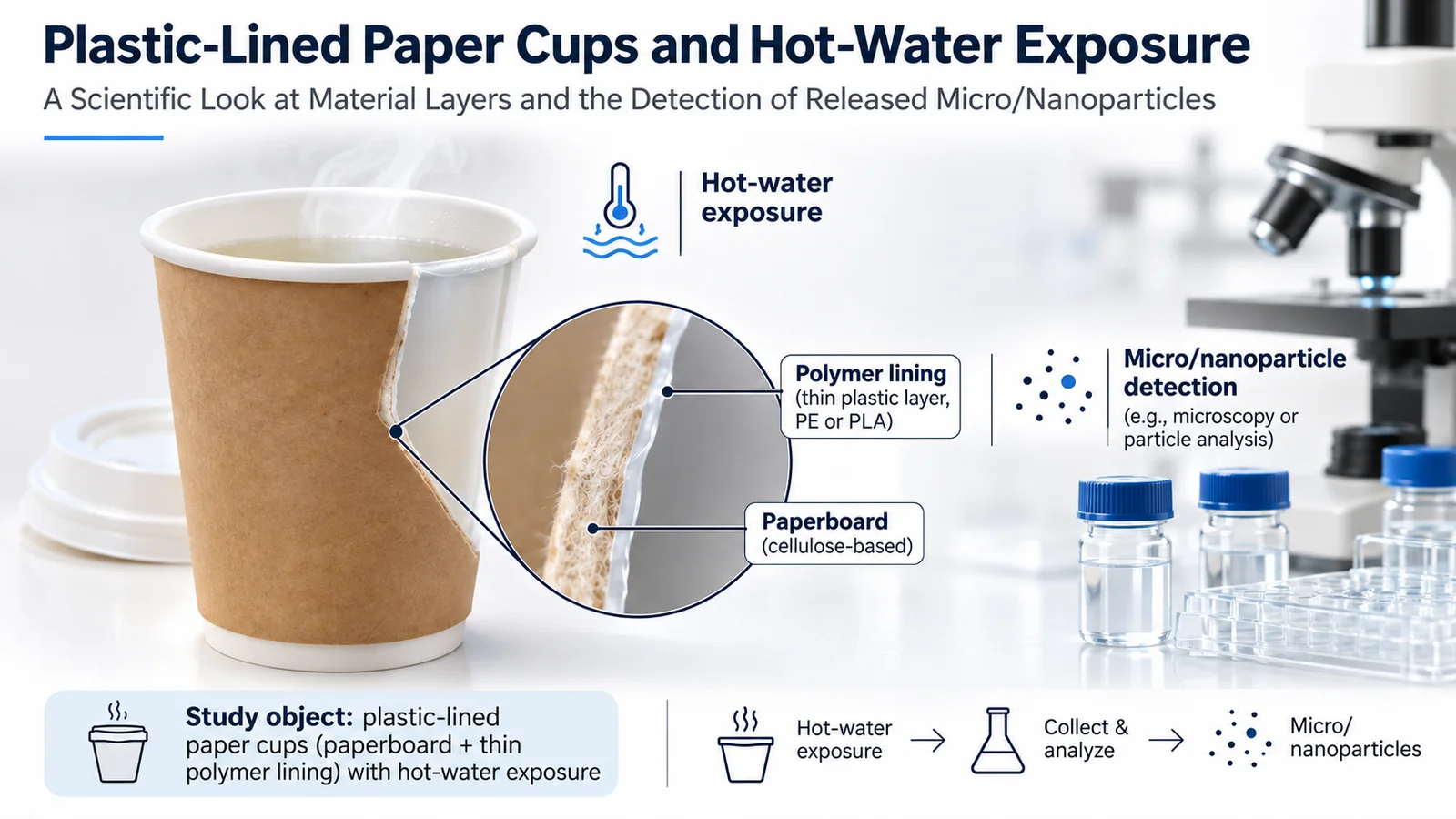
Yes. Laboratory researchers have measured micro- and nanoscale plastic material released from disposable coffee cups with polymer linings. A peer-reviewed study published in August 2026 compared paper cups lined with polyethylene (PE) and polylactic acid (PLA) during hot-water exposure. Both released particles; the PLA-lined cups released approximately twelve times the total particle mass measured from the PE-lined cups under the study conditions.
That finding deserves attention, but it needs precise interpretation. The researchers did not establish that PLA is inherently unsafe, prove a specific human health outcome, or test clear rigid PET and PLA cold-drink cups. A plastic-lined paper cup and a thermoformed transparent cup are different finished articles with different structures and intended uses.
For a packaging buyer, the relevant question is not simply whether a material is marketed as biodegradable or conventional. It is whether the product's performance and evidence match the way it will be used: hot coffee in a lined paper cup, iced coffee in a clear plastic cup, or another distinct food-contact application.
What Did the 2026 Coffee Cup Microplastics Study Actually Test?
The research, “Release of Nanoplastic and Microplastic from Polyethylene and Polylactic Acid Lined Single Use Paper Cups,” was published online on August 25, 2026, in ACS Food Science & Technology. The University of Queensland issued a public explanation on August 27. The work examined single-use paper cups with two kinds of waterproof polymer lining: PE and PLA.
The Cup Was Paperboard Plus a Polymer Lining
A conventional takeaway paper cup is not necessarily plastic-free. Its paperboard provides much of the structural body, while a thin inner lining helps resist liquid penetration. A cup advertised as paper may still expose the beverage to a polymer contact layer. For this study, the lining was the relevant material difference.
The Study Concerned Hot-Water Exposure
The researchers exposed the tested cup systems to hot water and examined particles released into that water. Their results apply to the tested materials and experimental conditions; they should not be copied into a product specification for an unrelated cup or a different temperature. The published abstract does not provide a general release rate for every brand, beverage, storage duration or repeated-use condition.
It Used More Than One Analytical Method
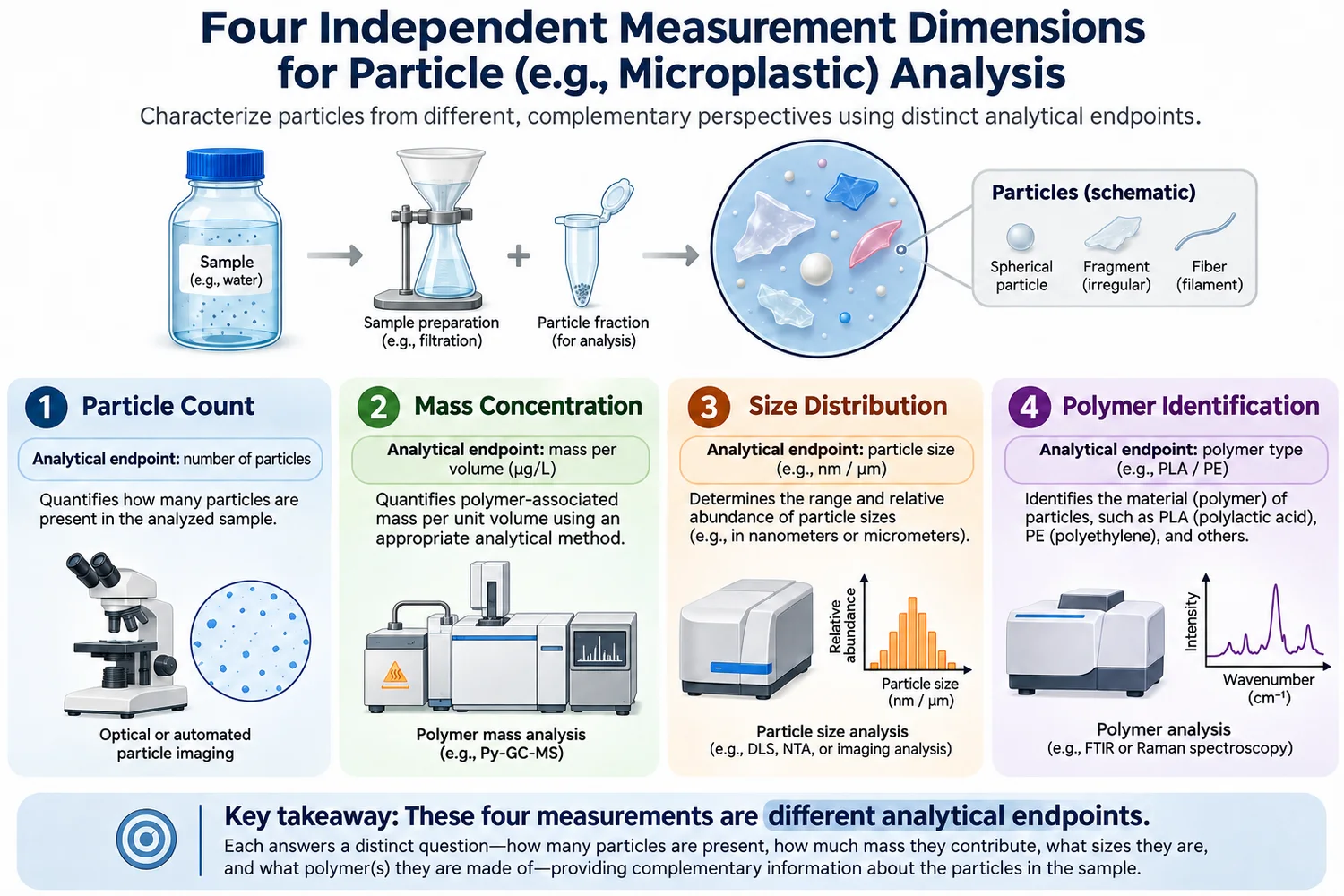
The paper describes a combination of pyrolysis–gas chromatography–mass spectrometry (Py-GC-MS), asymmetrical flow field-flow fractionation with multiangle light scattering (AF4-MALS), nanoparticle tracking analysis, and electron microscopy. These techniques address different questions: how much polymer-associated material is present, how particles are distributed by size, what can be chemically identified and what surface features are visible.
This multi-method approach matters because a particle count alone does not establish the polymer identity of every detected object. Buyers reading a laboratory report should ask what the instrument measured, what size range it could detect, and whether the reported signal was confirmed as the relevant polymer rather than assumed to be plastic.
PLA vs PE Paper Cup Linings: What Does the Twelve-Fold Result Mean?
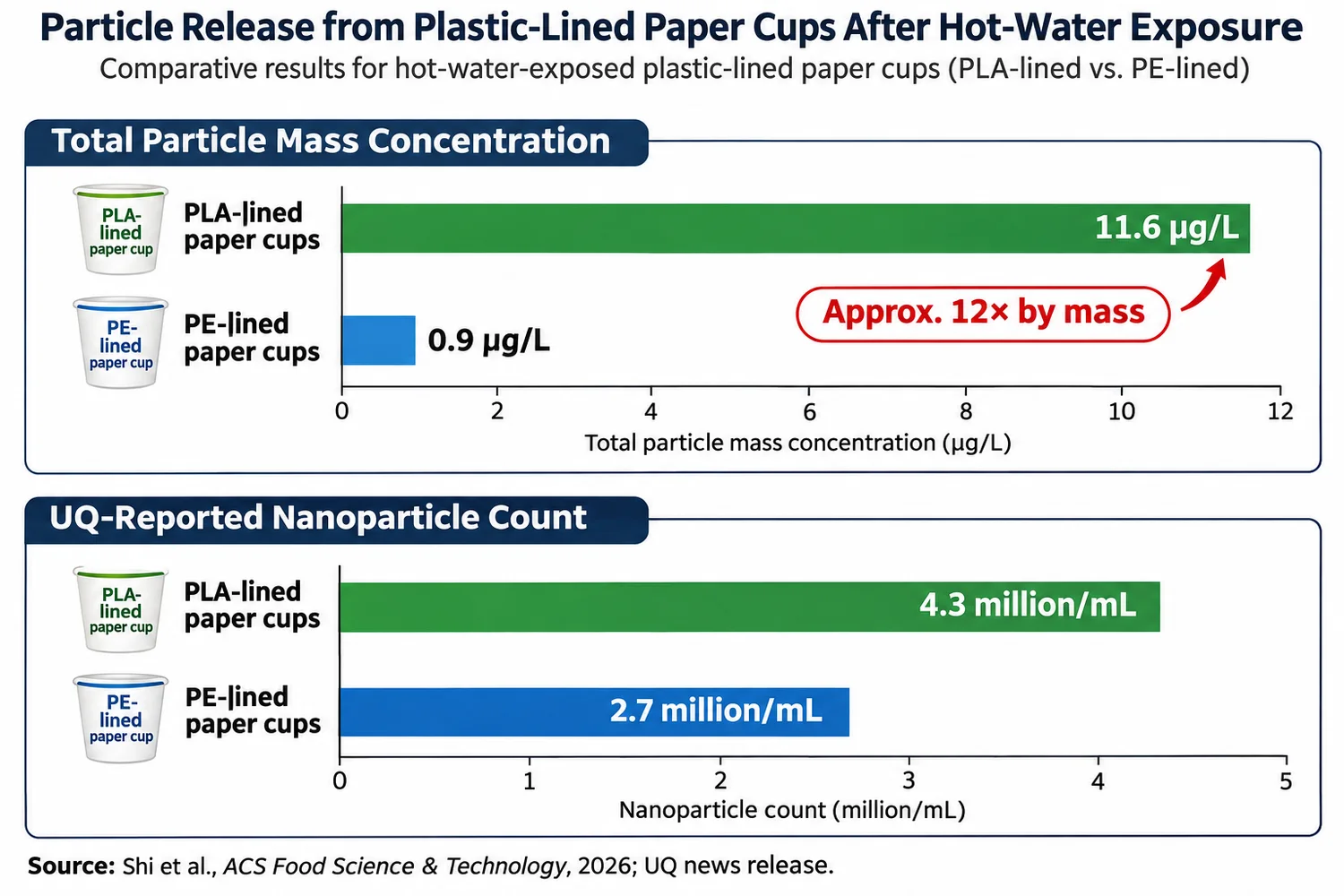
The headline difference is about the mass of released plastic material. The researchers reported 11.6 micrograms per litre for the PLA-lined paper cups and 0.9 micrograms per litre for the PE-lined paper cups under their experimental conditions. That is approximately a twelve-fold difference in total particle mass concentration.
| Reported Measurement | PLA-Lined Paper Cup | PE-Lined Paper Cup | Correct Interpretation |
|---|---|---|---|
| Total released particle mass concentration | 11.6 μg/L | 0.9 μg/L | Approximately 12-fold higher mass for PLA lining in this experiment |
| Nanoparticle count reported by UQ | Approximately 4.3 million/mL | Approximately 2.7 million/mL | Different measurement; the count ratio is not twelve-fold |
| Polymer-specific nanoscale findings | PLA-derived nanoparticles identified in selected size fractions | PE nanoparticles not detected in those analyses | A non-detection is limited to the method and fractions analyzed |
| Human health outcome measured | No | No | Particle-release evidence is not a clinical health-risk assessment |
The journal abstract identifies PLA-derived nanoparticles in the 60–130 nm and 200–300 nm fractions. It also reports that PE nanoparticles were not detected by the relevant polymer-specific nanoscale analyses. That should not be flattened into “the PE cups released zero particles”: the study also measured PE-associated total particle mass, and the University's particle-tracking figures include an estimate for the PE-lined cups. Different analytical endpoints must be kept separate.
Nor does the ratio tell buyers that every PLA-lined cup will release twelve times as many particles as every PE-lined cup. Product design, lining formulation, processing, exposure conditions and analytical procedures can affect the observations. The study establishes a result for the tested system, not a universal multiplier.
Why a Particle-Release Result Is Not a Material Safety Ranking
Particle release is an exposure-related measurement. A health-risk judgment requires additional evidence, including particle characteristics, realistic intake, biological behavior, dose–response relationships and uncertainty in the testing methods. These are connected questions, but they are not interchangeable.
The University of Queensland researchers explicitly cautioned that the findings do not mean people must stop using paper cups or that PLA is inherently unsafe. The researchers called for closer examination of particle-release behavior, especially for products intended for hot beverages. That is a narrower conclusion than social-media claims suggesting one cup material has been proven dangerous.
The study's surface analysis also found physical deformation of the PLA coatings after hot-water exposure without detectable chemical degradation. A lining can change physically and release measurable material without a study demonstrating bulk chemical breakdown. That distinction is important when a report uses the words softening, deformation, degradation or particle release.
Are PLA-Lined Paper Cups the Same as Clear PLA Plastic Cups?
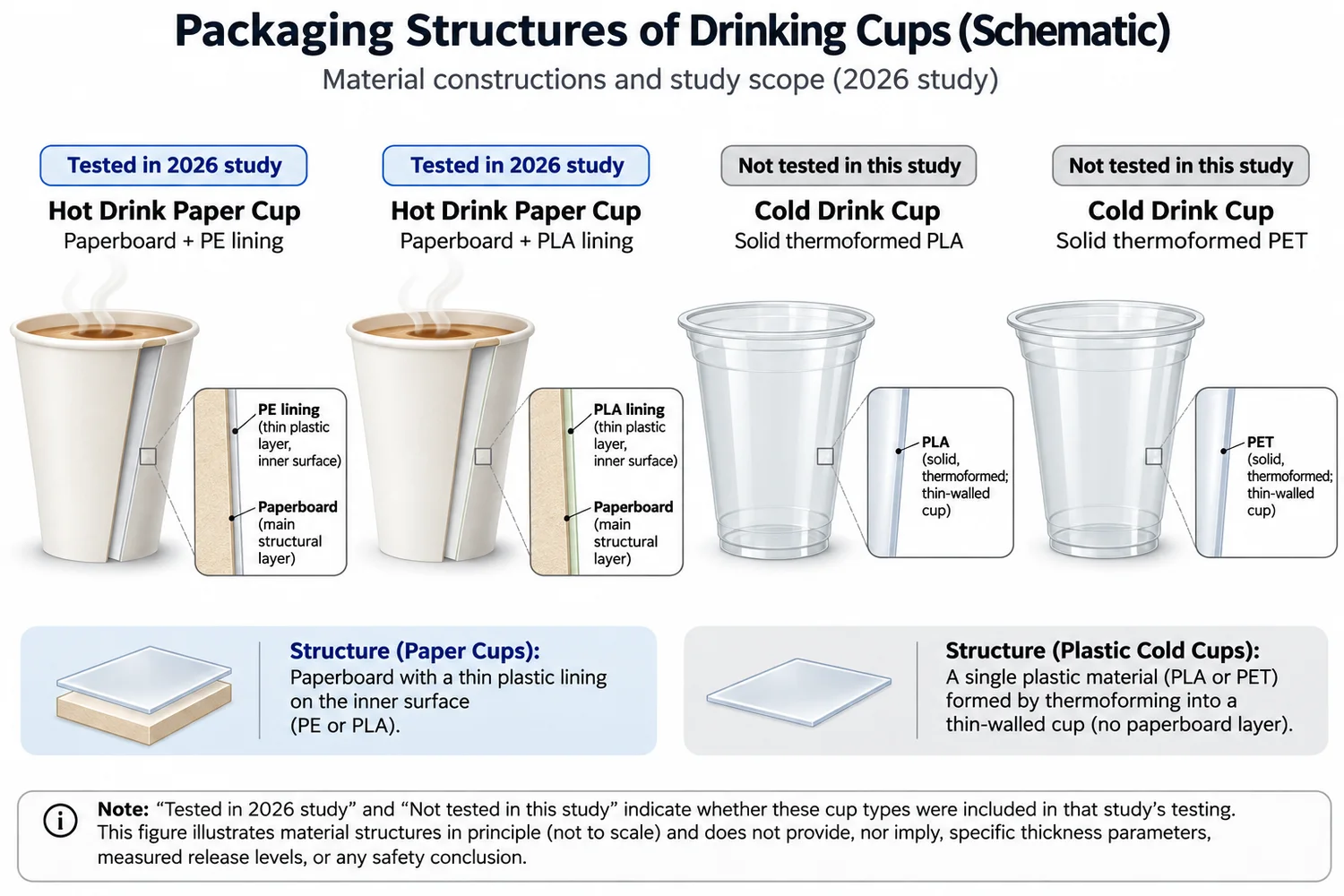
No. The polymer name can appear in both product descriptions, but the finished packaging structures are different. A PLA-lined paper cup uses paperboard with a thin PLA contact lining. A clear PLA cold cup is a rigid plastic article generally formed from a plastic sheet. They differ in substrate, layer structure, conversion process, wall geometry and typical service conditions.
That difference matters when researchers expose the drinking surface to heat. The response of a thin lining bonded to paperboard cannot automatically be applied to a free-standing thermoformed wall. The same caution applies to clear PET cups, which were not among the tested products in the 2026 paper.
| Finished Cup Structure | What Contacts the Beverage? | Directly Tested in the 2026 Study? | What a Buyer Must Verify |
|---|---|---|---|
| PE-lined paper coffee cup | Polyethylene lining on paperboard | Yes | Use conditions and evidence for the exact cup/lining |
| PLA-lined paper coffee cup | Polylactic acid lining on paperboard | Yes | Use conditions and evidence for the exact cup/lining |
| Clear thermoformed PLA cold cup | Rigid PLA cup wall | No | Cold-use specification, finished-product evidence and heat exposure limits |
| Clear thermoformed PET cold cup | Rigid PET cup wall | No | Finished-product evidence and actual intended food-contact conditions |
| PP drinking cup | Polypropylene cup wall | No | Product-specific use conditions and evidence; do not borrow the paper-cup values |
For Cupschina buyers choosing a clear cold cup, the material question belongs in the PET vs PLA cup selection guide. This article has a different purpose: to interpret what one paper-cup study can, and cannot, establish about particle release.
How Do Temperature and Contact Time Affect the Interpretation?
A disposable cup should be evaluated under the conditions in which it will actually contact a beverage. A hot coffee program and an iced-drink program can expose the food-contact surface to very different thermal environments. Contact time, filling practice, handling and product construction can also change the questions a test needs to answer.
The 2026 study specifically used hot-water exposure. That makes it directly relevant to examining the tested paper-cup linings under hot-liquid conditions, but it does not automatically quantify release from cold beverages or from an entirely different plastic article.
Define the Actual Beverage Condition
For a chain buying hot takeaway coffee cups, the useful specification starts with the maximum intended filling temperature, typical time before consumption, cup construction and relevant compliance conditions. For a brand buying transparent cold cups, it starts with the required chilled or iced beverage use and the exact finished cup. Testing should represent those separate situations, not simply use the same headline “food safe” label for both.
Do Not Treat Softening and Particle Release as Identical Measurements
The PLA lining in the paper-cup study showed physical deformation after hot-water exposure. That observation is relevant to interpreting the release result, but visible distortion and chemically confirmed particle release are different measurements. A finished cup may also have other performance limits—such as dimensional stability or lid function—that require separate testing.
Buyers of clear PLA cold cups should check the supplier's exact product-use and storage limitations. A resin melting point or data from a hot paper-cup lining does not substitute for the approved finished-cup application.
What Do Microplastic and Nanoplastic Measurements Actually Mean?
The terms microplastics and nanoplastics refer to small plastic particles, but detection methods and size definitions are not completely standardized across the literature. The study used working definitions of microplastics above 1 μm and nanoplastics from 10 to 1,000 nm. Different sources may use somewhat different thresholds.
For buyers reviewing a test report, four separate fields matter:
- Particle count: How many objects were detected within the instrument's measurable size range?
- Mass concentration: How much material was quantified per unit volume, such as micrograms per litre?
- Particle size: What fractions were measured or missed because of instrument limits?
- Polymer identification: Which measurements establish that the signal comes from PLA, PE, PET or another material?
These are not alternative names for one result. Two samples can have different particle counts and different mass concentrations because particle size and composition affect total mass. Instruments may also detect background particles or particles that have not been definitively identified as the suspected polymer.
That is why a report should document controls and blanks. Water, air, lab containers, handling equipment and analytical preparation can all introduce particles if contamination is not controlled. Without a clear analytical method, an isolated number cannot be compared responsibly with another laboratory's result.
Does Detecting Microplastics Mean Disposable Cups Are Unsafe?
Not by itself. Detecting particles is an important exposure observation. It is not the same as showing that a particular amount causes a defined health outcome in people. The scientific assessment needs information about the amount ingested, particle size, polymer characteristics, associated chemicals, biological effects and exposure over time.
The U.S. FDA's public scientific overview states that current evidence does not demonstrate that levels of microplastics and nanoplastics detected in foods pose a risk to human health. It also emphasizes substantial gaps in standardized measurement methods and health-effects data. This is a statement about the present state of evidence, not proof that every particle or every possible exposure is harmless.
The European Food Safety Authority's October 2026 overview similarly notes that knowledge about dietary exposure levels and potential human-health effects remains limited. Results from a hot-water cup experiment can inform future exposure research, but they do not supply all the information needed for a completed risk assessment.
| Question | What the Evidence Can Support | What It Cannot Yet Establish |
|---|---|---|
| Were particles detected in the experiment? | Yes, for the specific paper-cup systems and analytical conditions studied. | A universal release amount for every disposable cup. |
| Was there a difference between linings? | Yes, the measured total particle mass differed substantially. | A general ranking of every PLA- and PE-based food-contact product. |
| Did the study measure human illness? | No. It studied release from the cups. | A causal human disease outcome or a product-specific clinical risk level. |
| Is more research warranted? | Yes, particularly on realistic exposure and comparable analytical methods. | That all existing food-contact approvals have automatically been invalidated. |
Public-health uncertainty should not be used as a marketing loophole in either direction. Suppliers should not claim that a product is “microplastic-free” without a defensible, defined test basis, nor should they declare a competing material unsafe solely because it released particles under one laboratory condition.
What Does the Research Mean for PET and PLA Cold-Drink Cups?
The direct answer is limited: the 2026 study did not test rigid clear PET cups or rigid clear PLA cups. It therefore cannot be used to assign either of those cold-cup products the paper-cup lining values of 11.6 or 0.9 μg/L.
For cold-drink buyers, the correct application is to improve evidence discipline. If a supplier makes a particle-release claim for a clear PET or PLA cup, ask for a report covering that actual cup—or a technically justified representative article—under the intended food-contact conditions. An unrelated paper-cup study is not an adequate product test.
This also prevents a common commercial mistake: selecting PET, PLA or another material based on a single headline while ignoring lid compatibility, fill conditions, visual presentation, applicable food-contact documents and waste-stream requirements. For material selection, the PLA cold-cup selection guide and PET cold-cup buying guide address those finished-product decisions.
Food-Contact Compliance Is Not the Same as Microplastic-Release Testing
A food-contact declaration, a migration test and a particle-release study are not interchangeable documents. Each answers a different question, even when they concern the same cup.
| Evidence Type | What It Can Establish | What It Does Not Automatically Establish |
|---|---|---|
| Resin or component documentation | Information about a stated material, substance or formulation and its intended use limits. | Particle-release performance or compliance of every finished cup. |
| Food-contact compliance declaration | Stated regulatory basis and scope for the identified material or article. | That no micro- or nanoparticles can ever be released. |
| Migration test report | Results for named substances or overall migration under defined test conditions. | A measured microplastics particle count unless that analysis was specifically performed. |
| Micro-/nanoplastics test report | Particle-release observations within the stated sample, method and limits. | Full destination-market regulatory compliance or a clinical health conclusion. |
| Finished-cup quality inspection | Dimensions, appearance, rim fit and other physical product checks. | Chemical migration or microplastic release unless separately tested. |
For a U.S. project, food-contact evaluation depends on the applicable regulatory basis for the substances and their conditions of use. For an EU project, plastic food-contact requirements include the relevant material/article documentation and supporting evidence under the applicable framework. Neither jurisdiction's documentation should be reduced to a generic “FDA-approved cup” or “EU-safe plastic” sales statement.
The existing Food Contact Compliance for Plastic Cups guide covers the FDA and EU document-review workflow in detail. This article addresses the separate scientific question of how particle-release findings should be interpreted.
What Microplastic Testing Evidence Should Packaging Buyers Request?
There is no single laboratory result that can be treated as universal proof of “zero microplastics” across every particle size and use condition. Detection limits, contamination controls, analytical techniques and reporting conventions must be read before comparing numbers from different laboratories.
When a foodservice chain, distributor or importer decides that particle-release testing is relevant to its product approval, the test request should specify:
- Exact article: the cup SKU, lining or wall material, manufacturer and production configuration.
- Relevant use: beverage type or test medium, intended contact temperature, contact time and any handling conditions being represented.
- Particle-size window: the range measured by the methods and the important sizes that may fall below detection.
- Analytical outputs: whether the report provides mass, number, size distribution, confirmed polymer identity or some combination.
- Quality controls: procedural blanks, background contamination checks, replication, recoveries and detection/quantification limits where applicable.
- Sample traceability: lot or batch, production status, test date and relation to the finished article being ordered.
- Claim scope: exactly which conclusion the data support, and whether comparison with another material is methodologically valid.
If the buyer has not commissioned a specific particle-release evaluation, an honest supplier response should identify which food-contact and finished-product documents are available and which additional test would be needed. It should not substitute a standard migration report for a microplastics study.
How Bioleader Cups Approaches Evidence-Based Cup Selection
For Bioleader Cups, the useful manufacturer perspective is to connect product construction and intended use with the evidence the buyer needs. A transparent cup may look similar to another clear cup on a website, but that visual similarity is not enough to prove the same polymer, finished configuration, heat-use range or analytical behavior.
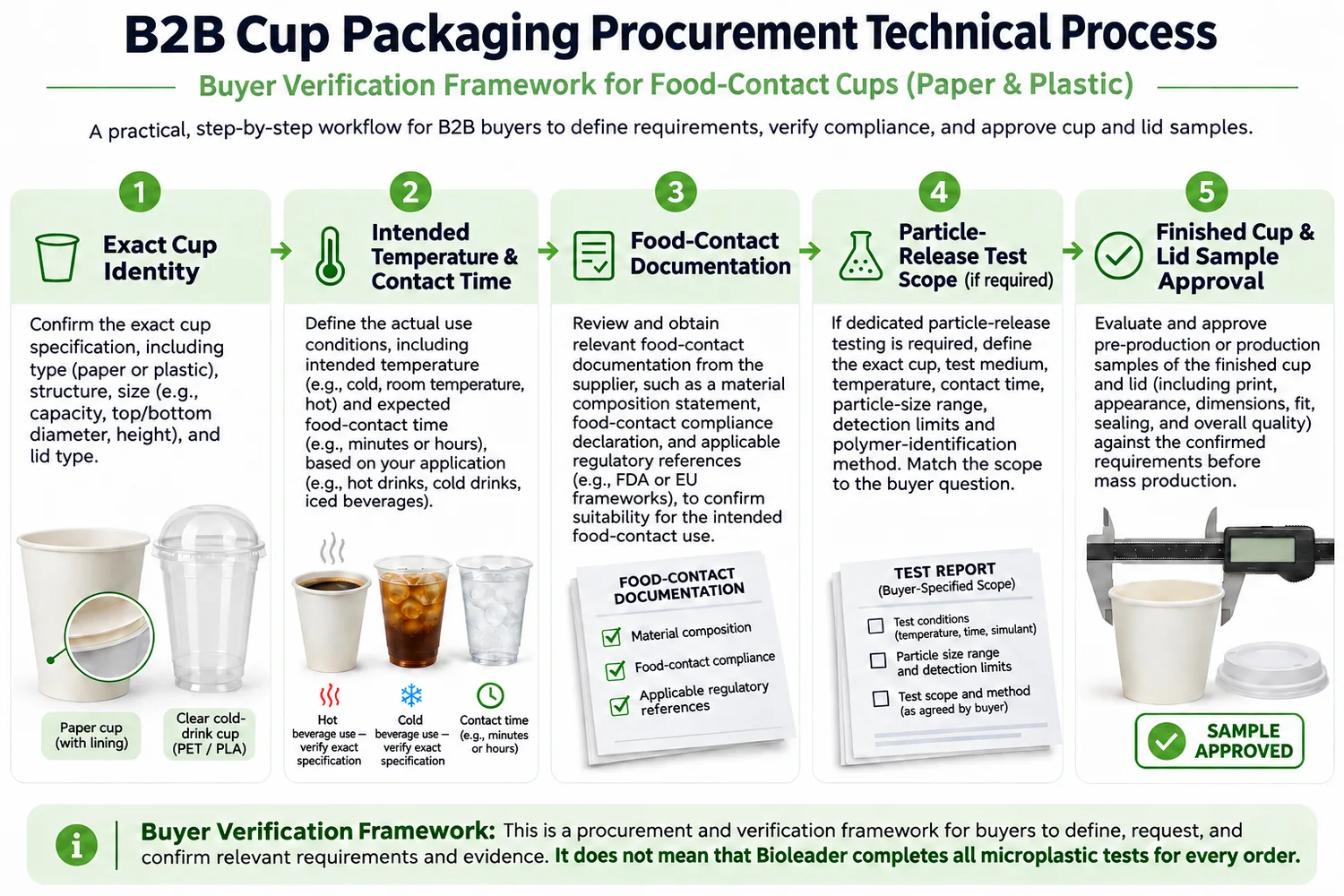
When assessing a cup program in light of studies such as the 2026 paper-cup research, the practical buyer–supplier review can follow these five checkpoints:
1. Identify the Finished Cup
Record whether the item is a paperboard cup with a lining or a rigid thermoformed plastic cup. Confirm the exact material and product reference. Do not use lining-test values for an unrelated clear cup.
2. Define the Service Conditions
Record the beverage, contact temperature, expected duration and actual handling requirement. Cold-use and hot-use cups should not be approved from one generic material claim.
3. Review Documents by Purpose
Match food-contact declarations and relevant migration reports to the destination market and finished SKU. Treat any dedicated particle-release evidence as a separate analytical question.
4. Match Studies to the Claim
If particle-release evidence is requested, review its product scope, medium, time, temperature, detection limits and polymer identification. Do not portray third-party research as a Bioleader SKU test.
5. Approve the Commercial Cup System
Once the material and document scope are clear, finished-cup acceptance still involves dimensions, rim geometry, matching lid, appearance, filled handling and the approved sample. For long-running orders, the evidence needs to remain tied to the same product configuration rather than a broad supplier-level claim.
Buyers can review the existing PLA cold-cup range and PET cold-cup range when selecting an application-specific product. The choice should follow the finished-cup specification and documentation—not an unsupported inference from a paper-lining experiment.
Buyer Checklist: Reviewing Cups After the 2026 Research
- Product type: Is the article a polymer-lined paper cup or a rigid PET/PLA cup?
- Material identity: Is the relevant food-contact layer or cup wall correctly identified?
- Use conditions: What beverage, filling temperature and contact duration does the buyer require?
- Study relevance: Was the same finished article, or a justified representative configuration, actually tested?
- Reported endpoint: Is the headline value particle mass, particle count, size or chemically confirmed polymer?
- Laboratory controls: Are blank controls, limitations, detection ranges and replication documented?
- Regulatory evidence: Do food-contact documents cover the destination market and exact article?
- Claim discipline: Are “microplastic-free,” “safer” or “twelve times more dangerous” claims excluded unless directly supported?
- Finished-product approval: Are cup dimensions, rim and lid compatibility and intended-use performance separately confirmed?
- Change control: Will the evidence be reviewed again if the material formulation, cup design or supplier changes?
The physical product and its documents should be locked together at the sample-approval stage. The Plastic Cup Sample Approval Guide explains how to preserve a reference for repeat supply; the Plastic Cup Quality Control Guide covers finished-cup inspection before shipment.
Final Recommendation
The 2026 study gives packaging buyers a legitimate reason to ask more precise questions about particle release from hot-drink paper cups. It shows measurable release from the PE- and PLA-lined articles studied and a substantial difference in total measured particle mass. It does not justify declaring all PLA packaging unsafe, all PE packaging safe, or either PET or PLA rigid cold cups superior on microplastic release.
For a hot-coffee program, evaluate the actual lined paper cup and its intended exposure conditions. For a cold-drink program, evaluate the actual transparent cup, not numbers from a paper lining. In either case, keep food-contact compliance, dedicated particle-release evidence and finished-cup performance as separate approval questions.
The next useful action is to send the exact cup reference, intended beverage, contact temperature, destination market and required evidence to the supplier. Where existing documents cannot answer the particle-release question, identify the missing test rather than replacing it with a marketing claim. Contact Cupschina with the finished-cup specification and document requirements for a product-specific review.
Frequently Asked Questions
Do disposable paper coffee cups release microplastics?
Some do under the conditions researchers have tested. A 2026 study measured micro- and nanoscale plastic material released from paper cups with PE and PLA linings during hot-water exposure. The result applies to those tested lining systems and conditions, not to every disposable coffee cup or every beverage.
Did the 2026 study find twelve times more microplastic particles from PLA cups?
The approximately twelve-fold comparison refers to total released particle mass concentration: 11.6 μg/L for the PLA-lined paper cups versus 0.9 μg/L for the PE-lined paper cups. The University of Queensland separately reported nanoparticle counts of approximately 4.3 million/mL and 2.7 million/mL. Mass and particle number are different measurements.
Is a PLA-lined paper cup the same as a clear PLA cold cup?
No. A PLA-lined paper cup combines paperboard with a polymer lining; a clear PLA cold cup is a rigid formed plastic article. Their construction, converting process and typical use conditions differ. Findings from a hot-water paper-cup lining study cannot automatically be transferred to clear thermoformed PLA cups.
Does this research prove that PET cold cups release fewer microplastics?
No. Rigid PET cold cups were not tested in that study, and the result cannot establish their particle-release level or a safety ranking against PLA. PET cup claims would require evidence for the actual finished PET article under relevant use conditions.
What should buyers request when a supplier makes a microplastics claim?
Ask for the exact tested product, contact medium, time and temperature, particle-size detection range, analytical method, polymer identification, blanks and quality controls, and a statement of what the data support. Review food-contact compliance and finished-cup quality documentation separately; a standard migration test is not automatically a microplastics-release test.
References
- Shi, K., Okoffo, E. D., et al. (2026). Release of Nanoplastic and Microplastic from Polyethylene and Polylactic Acid Lined Single Use Paper Cups. ACS Food Science & Technology. Published online August 25, 2026. DOI: 10.1021/acsfoodscitech.6c00541.
- The University of Queensland (August 27, 2026). Takeaway Cups Release Microplastics into Your Coffee.
- U.S. Food and Drug Administration. Microplastics and Nanoplastics in Foods.
- European Food Safety Authority. Microplastics and Nanoplastics in Food. Last reviewed October 21, 2026.