Quick Summary
- Some cafés use paper-based cups for iced drinks because of local requirements or packaging policies, but a paper cup is not automatically a better replacement for every beverage. Compare drink visibility, cold-cup construction, lid fit, collection routes and total operational cost; approve the actual filled cup-and-lid system before switching.
Some coffee shops are serving iced coffee in paper cups instead of the familiar clear plastic cups. The change can answer a local packaging rule or a brand's waste-reduction policy, but it also changes how customers see a layered latte, how a lid works and how the used package is collected. For cafés, the best paper-versus-plastic cup decision is a finished-service decision, not a material slogan. Test the beverage, cup, lid, branding, disposal route and cost together before replacing an established cold-cup program.
The issue is more specific than asking whether paper or plastic is greener. An iced Americano, a visually layered matcha latte and a fruit tea with visible pieces do not depend on their packaging in the same way. An operator must also distinguish a purpose-designed paper cold cup from an ordinary hot-drink cup. Their coatings, external moisture resistance and approved service conditions may differ.
Quick decision: choose by local legal requirements first; then assess beverage visibility, verified cold-use performance, the exact cup-and-lid pairing, waste-system acceptance and total cost per drink served. A material name alone does not resolve any of those six questions.
Why Are Some Coffee Shops Replacing Clear Plastic Cups?
Three reasons commonly appear in a cup-replacement brief: an applicable local rule, a company packaging commitment, or a customer-experience strategy. They need different answers. A legal requirement determines which materials and finished packages may be supplied. A corporate target may set preferred formats even when a conventional plastic cup remains legal. A café-led choice may prioritize appearance, handling or operational simplicity.
Local regulations are not a global plastic-cup ban
Starbucks states in its official cup program that a small number of stores provide commercially compostable cups and lids because of local government requirements. That is evidence of a limited, location-specific packaging change—not evidence that all Starbucks locations have abandoned clear cold cups. For an international café chain, one market's approved cup should not automatically become the specification for every other market.
Before using a paper cup as a compliance alternative, identify the jurisdiction and check the rule's definitions. Some rules address conventional plastic, some address broader single-use foodware, and others require certified compostability or reusable options. A paper-looking cup with a polymer lining is not necessarily exempt from every restriction. Likewise, a PLA cup is a plastic cup, even when it has a supported industrial-compostability claim.
Brand targets and drink design create other trade-offs
A switch can simplify the story a brand tells about materials, but it may complicate the drinks it sells. In a discussion among Starbucks employees and customers, participants questioned why visually striking cold drinks were being served in opaque cups at some stores. Their comments are anecdotal feedback, not a representative consumer survey or proof of lost sales. They do, however, identify a practical issue worth testing: product visibility is part of some beverage experiences.
What Changes When Customers Cannot See Their Iced Drinks?
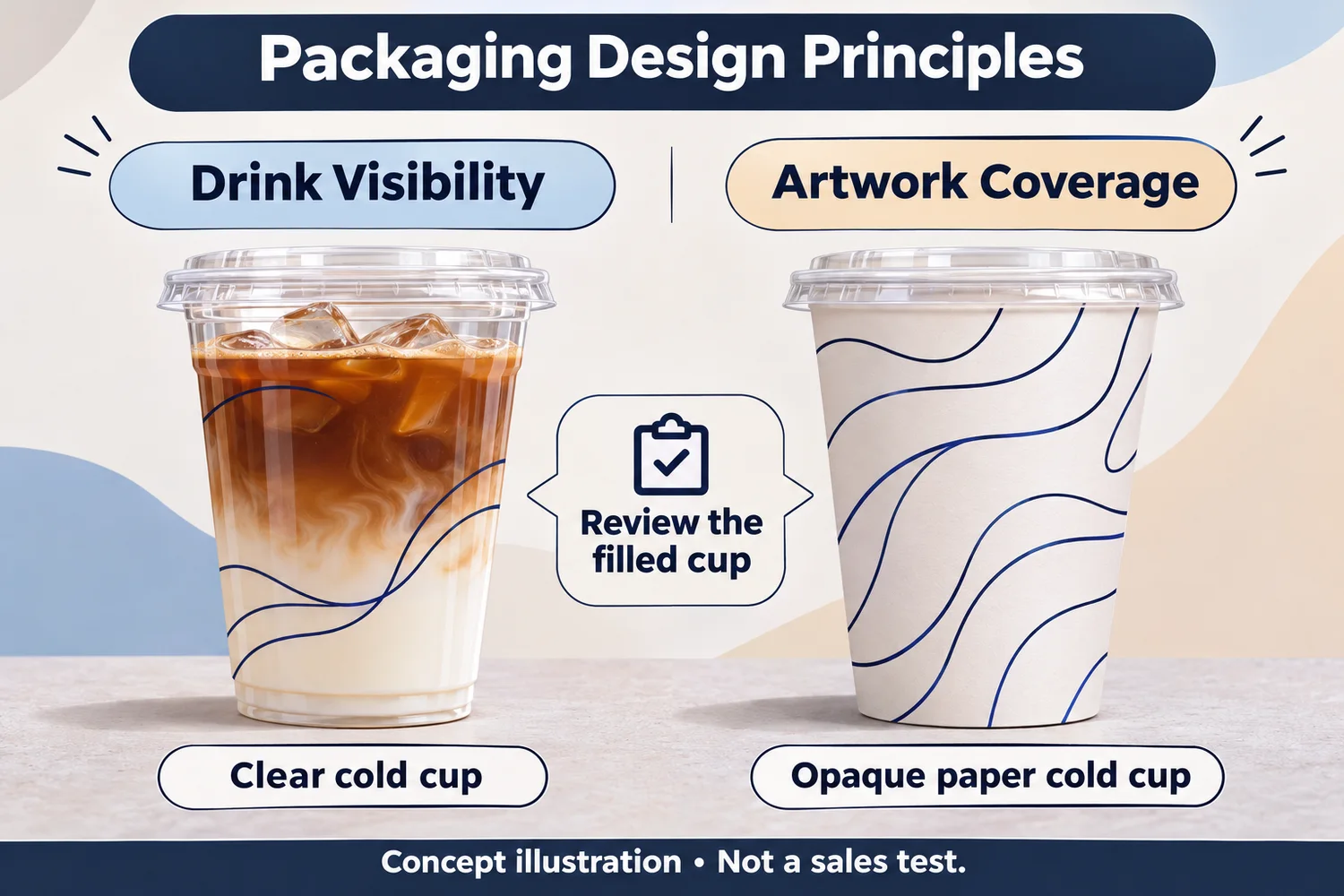
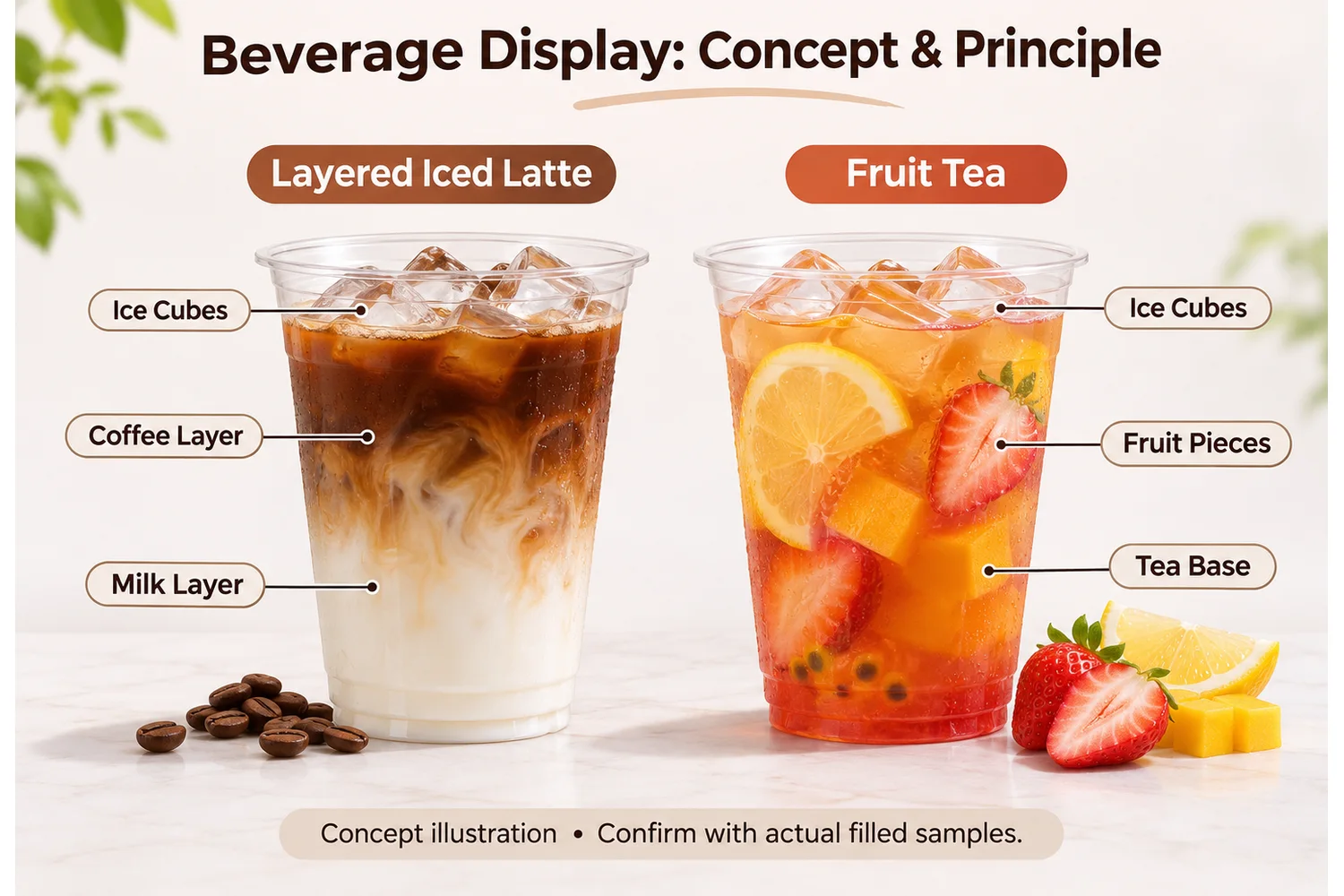
Clear packaging allows the drink to carry part of the message. Customers can see the color of an iced Americano, the boundary between espresso and milk, the green-and-white layers of matcha, or the fruit pieces inside a tea. In an opaque cup, that information disappears until the lid is opened. Whether that matters depends on the menu and the brand's sales channel.
Layered drinks, fruit tea and visual merchandising
For an iced latte or matcha drink intentionally prepared with visible layers, a transparent cup lets the presentation remain visible at the counter and in customer photographs. For fruit tea or bubble tea, transparency can show ingredients that differentiate one menu item from another. By contrast, a plain cold brew sold primarily on flavor, convenience or brand recognition may rely much less on a visible product window.
This does not establish that clear cups increase sales by a fixed percentage. A café should measure its own response: presentation ratings, customer questions, repeat purchases where measurable, and the share of drinks whose appearance is central to the menu. Brand and product visibility are competing design priorities; the correct balance may vary by drink.
Printed paper cups shift attention to the brand
An opaque paper cup offers a continuous surface for a graphic, campaign or branded message. That can work especially well for a café with strong visual identity and drinks whose ingredients do not need to be visible. Clear plastic cups can also be branded, but artwork coverage must be balanced against the view of the beverage. The existing custom cup branding and drink visibility guide explains why the real filled cup, rather than a flat design proof, should govern artwork approval.
Can Paper Cups Handle Iced Drinks and Condensation?
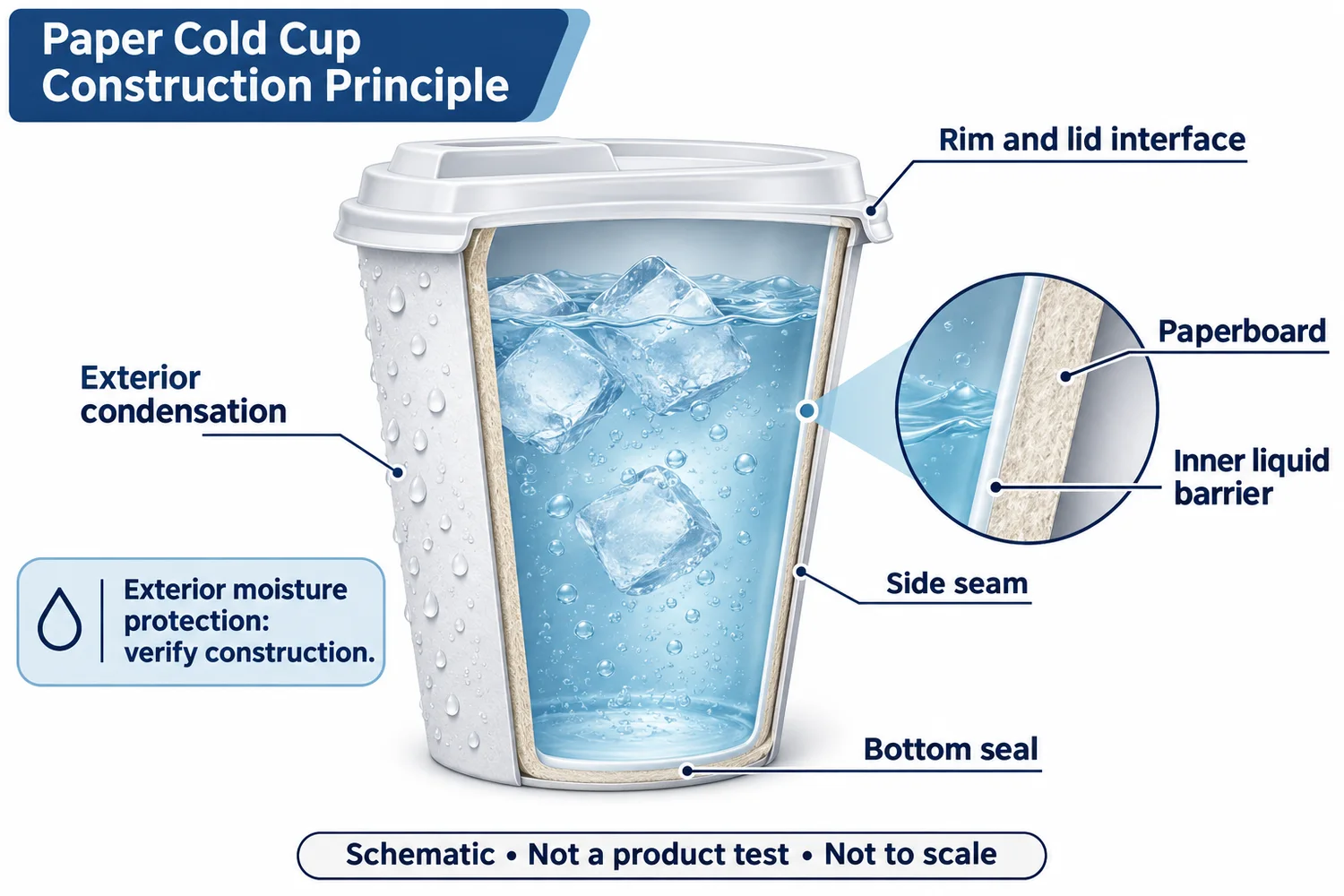
They can, provided the finished cup is designed and approved for cold beverage service. The question is not whether the material is called paper; it is how the cup's inside, outside, side seam, bottom seal and rim behave during the actual hold time. A hot cup should not be treated as an approved cold cup simply because the drink physically fits.
The inner liquid barrier is not the same as exterior condensation resistance
Paper cups typically use a liquid barrier on the food-contact side. Depending on the product construction, this may be a polymer lining or another specified barrier system. Cold drinks can also produce condensation on the outside. If external moisture enters the paperboard, the sidewall, seam or bottom region may lose stiffness even though liquid has not leaked through the inner surface. The relevant outcome depends on construction, humidity, beverage temperature and holding time.
That is why the buyer should request the exact cold-use specification rather than a generic claim that a cup is waterproof. A purpose-designed cold cup may be suitable for prolonged iced-drink use, but no universal one-hour or two-hour performance guarantee should be inferred without a product-specific test.
Lid seating and grip pressure also matter
Changing cup material can change rim stiffness, rim shape and the locking behavior of the lid. A lid that fits one plastic cup should not be transferred to a paper cup simply because the nominal diameter appears the same. Review full-perimeter seating, ease of application, lift points, sidewall compression and leaking around the drinking opening. For a technical failure checklist, see the cup lid compatibility problems guide.
Common substitution error: a café tests the paper cup empty, approves its appearance, then discovers that the finished iced drink produces exterior moisture, changes the grip feel or makes the selected lid less reliable. Approve the complete filled cup-and-lid system under the intended service conditions.
Paper vs PET vs PLA Cups: The Practical Cold-Drink Comparison
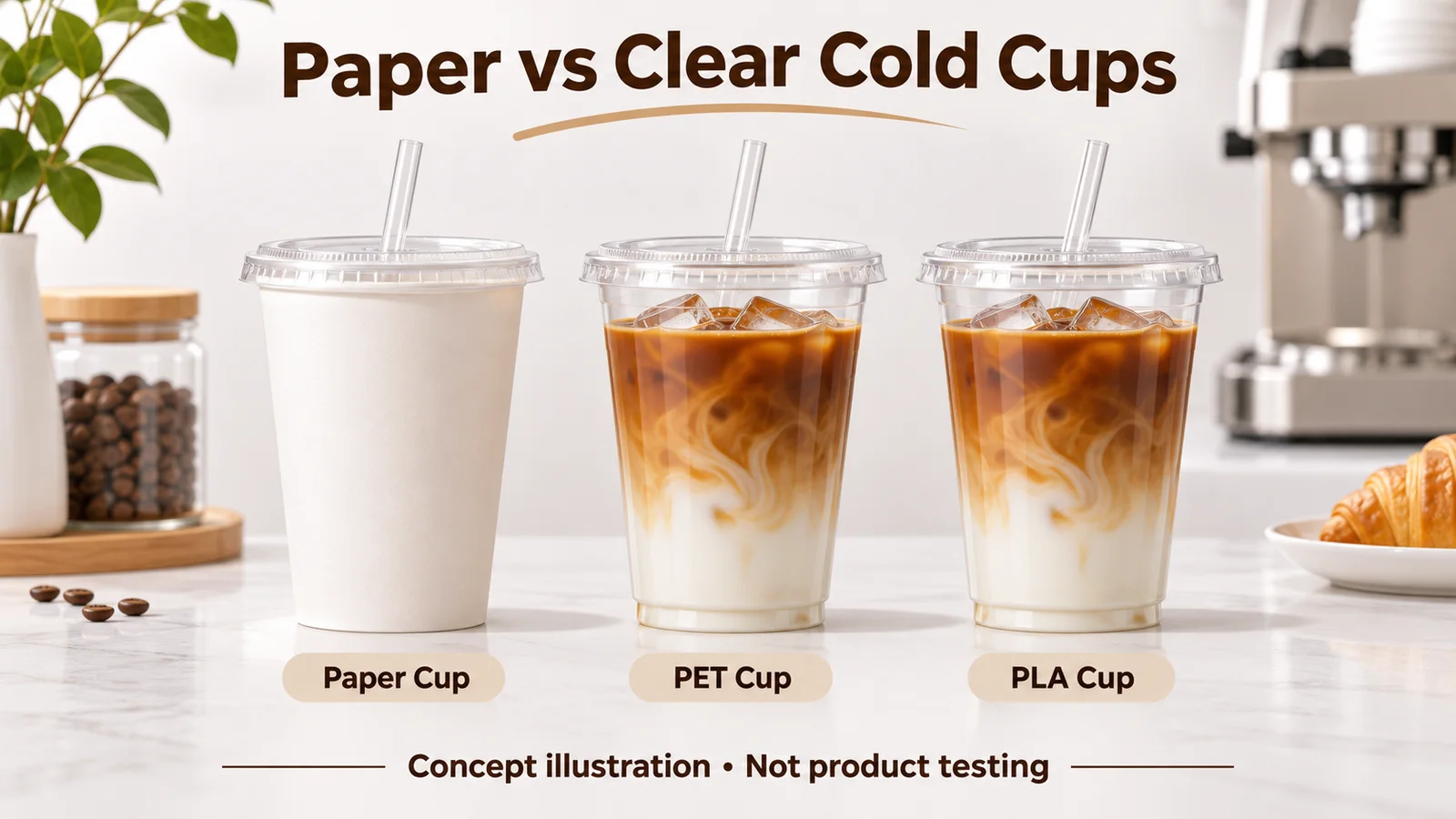
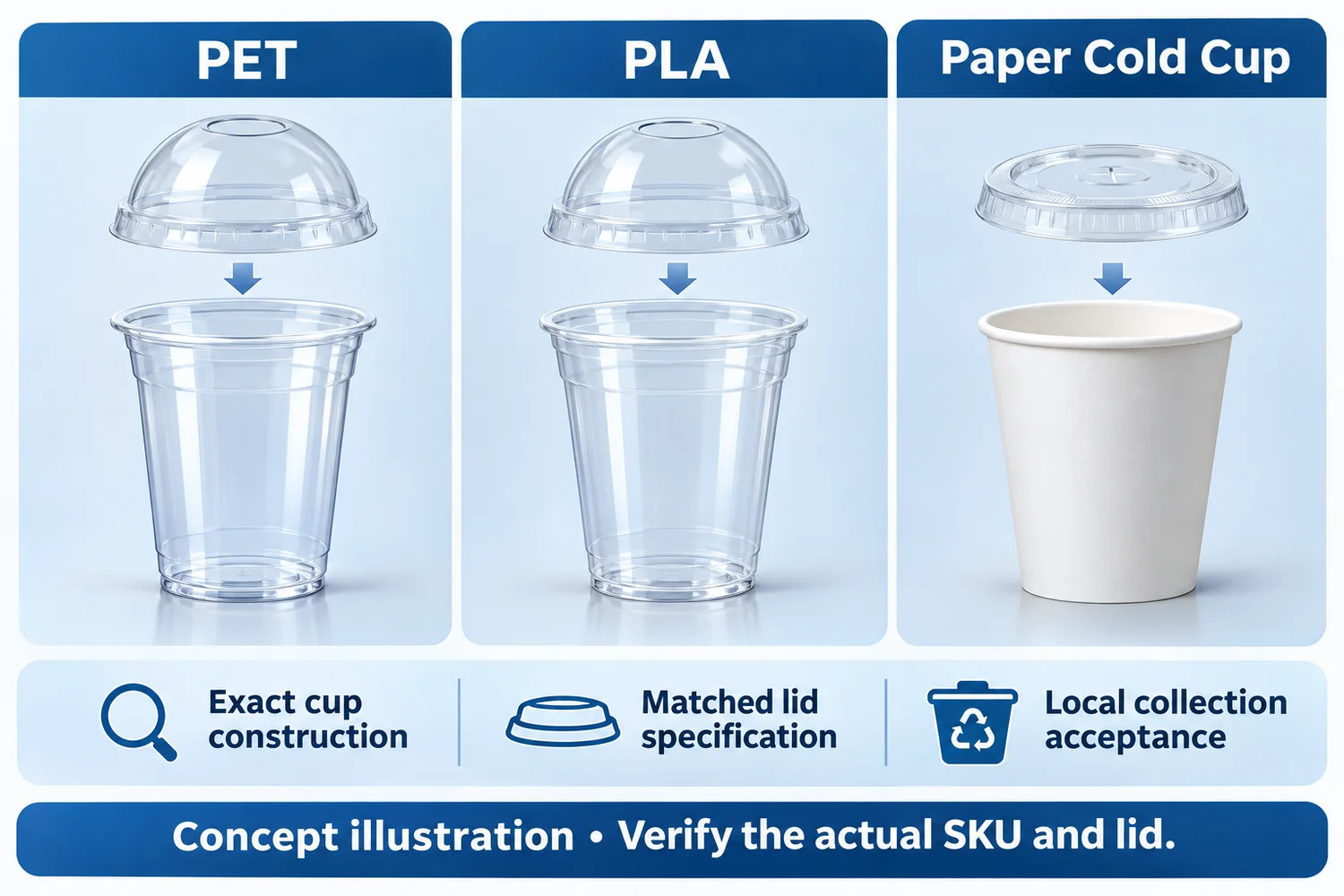
A café considering paper cups often needs to compare three different finished systems, not only two materials: a conventional clear PET cold cup, a clear PLA cold cup, and a paperboard cold cup with an identified barrier construction. PET and PLA can both provide clear product presentation for cold drinks, but their material identity and potential end-of-life pathways differ. Paperboard is opaque and can offer a different printing surface, while its performance depends on the complete coated cup.
| Buyer criterion | Clear PET cold cup | Clear PLA cold cup | Paper cold cup |
|---|---|---|---|
| Product visibility | Clear view of drink, layers and inclusions. | Clear view of drink, layers and inclusions. | Opaque; printed surface carries the presentation. |
| Intended beverage | Cold drinks when approved for the exact SKU. | Cold drinks when approved for the exact SKU. | Cold drinks when the complete cup is designed and approved for them. |
| Moisture assessment | Evaluate finished-cup handling, rigidity and seal. | Evaluate finished-cup handling, rigidity and seal. | Evaluate inside barrier, exterior condensation, seams and bottom. |
| Lid approval | Match exact rim and lid SKU. | Match exact rim and lid SKU. | Match exact paper-cup rim and lid SKU. |
| Environmental pathway | PET collection and reprocessing where available for the finished cup. | Industrial composting only where finished-product evidence and collection conditions support it. | Recycling or composting depends on the actual lining, finished-cup evidence and local facilities. |
| Regulatory suitability | Confirm against the destination market's rules. | Confirm against the destination market's rules; PLA is still plastic. | Confirm against the destination market's rules and finished construction. |
| Best reason to shortlist | Transparent, conventional cold-drink presentation. | Transparent cold-drink presentation with a verified compostability program requirement. | Opaque branding or a requirement best met by an approved paper-based format. |
For a conventional transparent cold-drink program, review the clear PET cold cup range. When the buyer has a defined industrial-compostability requirement and a credible collection route, evaluate the clear PLA cold drink cup range with product-specific documentation. Neither option should be called universally more sustainable without defining the comparison and the end-of-life conditions.
Is Switching to Paper Always Better for the Environment?
No. It can be the right choice for a particular policy or waste system, but changing the visible material does not establish a better environmental result. A credible comparison must specify the finished package, any barrier or lid components, the available collection route and what happens after the cup is discarded. It should also define whether the question is about fossil-based plastic use, litter, greenhouse-gas emissions, material recovery, compostability or another impact.
Technically recyclable does not mean collected and recycled
A clear PET cup may be compatible with certain recycling pathways, but PET resin identification does not prove that a local collector accepts that specific cup. A paper cup may be recyclable in a suitable paper-cup recovery system, but the presence and chemistry of the barrier layer and the local mill's capabilities matter. The distinction is explained in the PET cup recycling claims guide.
Compostable claims need a real collection route
Commercial compostability is also conditional. A finished cup and lid may need separate verification, the destination facility must accept the material, and collection arrangements must keep the intended compostable stream separate. PLA should never be presented as ordinary PET recycling material or as automatically home compostable. The buyer should establish whether the replacement solves a real collection problem or only changes the wording on a purchasing sheet.
Procurement principle: request evidence for the exact cup, lid and destination market. “Paper,” “PET,” “plant-based,” “recyclable” and “compostable” describe different things. None is, by itself, a verified end-of-life outcome.
Which Cup Is Best for Different Iced Drinks?
The drink's visual role and operating conditions should determine the shortlist. The following matrix provides starting questions, not universal material rankings. Any selected format still needs a filled-cup test and a destination-market compliance check.
| Menu item | What customers or operators notice | Practical starting point |
|---|---|---|
| Iced Americano | Convenience, fill, secure drinking access. | Either a suitable paper cold cup or a clear cold cup may work; validate the lid and cost. |
| Layered iced latte | Coffee–milk contrast and appearance. | Shortlist a clear cup when the visual layer is part of the product promise. |
| Iced matcha latte | Color, layers and brand presentation. | Test clear-cup visibility against the desired printed-paper look. |
| Fruit tea | Fruit pieces, colors and inclusions. | Consider clear presentation, then confirm sealing or lid access. |
| Bubble tea | Pearls, toppings, straw and sealing-film compatibility. | Approve the complete cup, seal or lid, and topping/headspace system. |
| Delivery cold brew | Spill resistance, holding time and handling. | Prioritize the actual closed-package transport result over transparency. |
| Market with packaging restrictions | Legal suitability and end-of-life acceptance. | Apply the local rule first; test only permitted, documented alternatives. |
The existing iced coffee cup sizes and lid selection guide addresses ice displacement, headspace, rim systems and drink-access details once the café has chosen a material direction. This article instead focuses on whether a replacement cup changes the café's customer experience and operating model.
Does Switching to Paper Cups Cost More?
A cup-price quote is not the total cost of the service system. A new format can change the lid SKU, printed artwork, case dimensions, storage space, operator training and the number of cups or lids lost through damage or poor fit. Conversely, a standardized paper-cup program may simplify some buying or branding workflows. The correct result is specific to the café's purchase volume, menu and distribution arrangements.
| Cost component | Calculation or buyer check | Why it matters in a replacement |
|---|---|---|
| Cup | Quoted landed cost per cup. | The new material or construction may change purchase price and freight volume. |
| Lid or sealing system | Matched lid or film cost per served drink. | Old lids may not be compatible with a new rim or material. |
| Print and setup | Artwork, sampling, plate or setup cost allocated across the program. | Changing the substrate usually requires a new print approval. |
| Storage and handling | Carton volume, picking effort, SKU count and changeover time. | Different sleeves or cases affect café and distributor operations. |
| Failures and waste | Observed failed servings × defined replacement or clean-up cost. | Leakage, softening or poor fit can outweigh a small unit-price difference. |
| Total served-drink cost | Sum approved costs, adjusted for actual wastage. | Compare on the same finished drink and service volume. |
For a printed PET or PLA alternative, use the custom printed cups program to develop a comparable specification before asking suppliers to price the same beverage application. Do not compare a plain unprinted paper cup with a premium printed clear cup and call the difference a material-cost result.
How Should a Coffee Shop Test a Paper-for-Plastic Cup Switch?
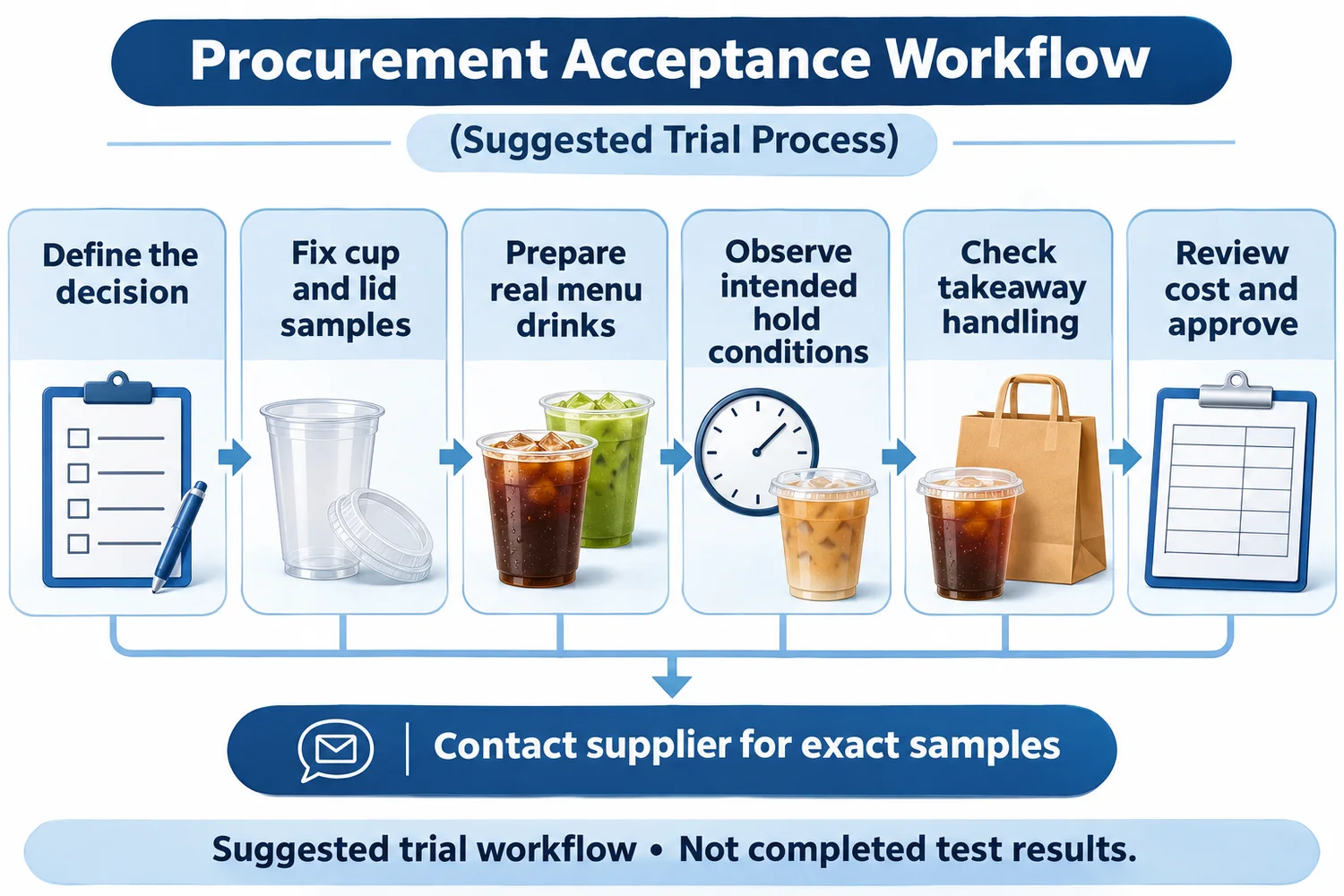
Use a controlled side-by-side trial. Choose the drinks that represent the actual menu, use the intended lids and prepare the products under the same operating conditions. The steps below are a recommended test protocol, not a statement that CupsChina or Bioleader has already tested these cup pairs.
- Define the decision. Record whether the trigger is a legal requirement, a corporate packaging policy, a waste-stream constraint or a proposed customer-experience improvement. List the allowed cup constructions in the target market.
- Choose exact samples. Identify each cup SKU, material or lining, nominal and working capacity, rim geometry, matching lid and artwork state. For a starting clear-cup comparison, the 16oz clear PET cup series provides documented variants—but the selected variant must be fixed before sampling.
- Prepare representative drinks. Make the real iced Americano, layered latte, fruit tea or cold brew with usual ice, toppings, finished fill and headspace. Compare appearance, grip and ease of service at the start.
- Inspect during the intended holding period. Use documented checkpoints such as 0, 15, 30 and 60 minutes where relevant. Observe exterior condensation, paperboard stiffness, seams, bottom, lid seating, visual presentation and customer handling. These are suggested observation times, not performance guarantees.
- Repeat realistic takeaway handling. Test the actual carrier, cupholder or delivery bag with defined safe handling motions. Record spill or lid-lift incidents and distinguish a cup-wall problem from a lid problem.
- Compare operational outcomes. Record staff handling time, failures, customer feedback, total served-drink cost and waste collection assumptions. Approve the new format only if it meets the agreed legal, performance and commercial requirements.
What to retain for repeat orders: the approved cup and lid SKUs, actual filled sample photographs, test method and conditions, print artwork revision, applicable compliance documents, outer-carton specification and the agreed supplier/buyer sample approval record.
What If Conventional Plastic Cups Are Restricted?
Start with the exact rule, not with a substitute material recommended for another region. The alternatives may include a compliant paper-based cold cup, a reusable service system or another permitted finished package. A clear PLA cup should not be assumed acceptable simply because PLA can be sold as compostable in certain certified applications; local definitions of plastic and the acceptance of compostable plastics vary. Equally, a paper cup's lining and lid may determine whether it meets a particular requirement.
For multi-location operators, maintain a location-specific material and claims matrix. One global artwork system can still be adapted to different permitted cup and lid systems, but product approvals and disposal messages must follow the market in which the drink is actually sold.
Bioleader Cups Buyer Recommendation
Our packaging-selection view: do not replace a successful clear cold cup program merely because an opaque paper cup sounds more sustainable. If the jurisdiction requires a different format, that requirement comes first. Otherwise, evaluate the drink's role in the brand, the actual cold-cup construction, lid compatibility and the available collection route. Clear PET is a logical starting option when conventional transparent cold-drink presentation is the principal requirement; PLA deserves consideration when a defined industrial-compostability program and evidence support it; paper cold cups should be reviewed as complete barrier-and-lid systems.
To request a meaningful comparison, contact Bioleader Cups with your drink types, expected fill and ice loading, intended hold time, required rim and lid, printing needs, destination market and estimated order volume. Ask for a recommendation based on the same finished-service brief rather than comparing unrelated samples or unsupported environmental claims.
Frequently Asked Questions
Why do some coffee shops use paper cups for iced drinks?
Some operators use paper-based cold cups because of local packaging rules, internal material policies or branding preferences. It is not a universal industry switch. The right choice depends on the specific jurisdiction, finished-cup construction, intended iced drink and available waste-management route. A compliant paper cup must still perform adequately with the chosen lid during real service.
Are paper cups better than plastic cups for iced coffee?
Neither material is automatically better in every café. Clear PET or PLA cups can display iced coffee, layers and inclusions. A purpose-designed paper cold cup may suit an opaque branded presentation or a specific regulatory requirement. Compare the finished cup, lid fit, cold-service performance, total cost and local end-of-life pathway before deciding.
Can paper cups become soggy from condensation?
They can if moisture reaches vulnerable paperboard areas, especially during prolonged cold service. Actual performance depends on exterior moisture protection, paperboard construction, seams, humidity and holding time. A cup designed for hot drinks should not be assumed suitable for iced drinks. Test the exact paper cold cup with a representative beverage under the expected service conditions.
Are paper cold cups easier to recycle than PET cups?
Not automatically. Some paper-cup recovery systems can process suitable coated cups, while other local programs exclude them. PET cup acceptance also varies from PET bottle collection. Check the complete package, lining, lid and local collector or processor rather than relying only on material labels or recycling symbols.
What should a café test before changing cup material?
Test representative finished drinks in the exact candidate cup-and-lid combinations. Check drink visibility, condensation, rigidity, lid seating, leak resistance, holding time, customer handling and relevant local compliance. Include the new unit cost, lid cost, printing, storage and recorded wastage. Keep the approved physical sample and specification as the reference for repeat purchases.